


US President Donald Trump on Thursday, June 11, warned that American forces would hit Iran “very hard tonight”, signalling a further escalation in tensions between Washington and Tehran amid a widening regional crisis.
In remarks posted on social media, Trump claimed Iran’s naval, radar and air defence capabilities had been significantly degraded and suggested that key oil infrastructure could become a target in future operations.
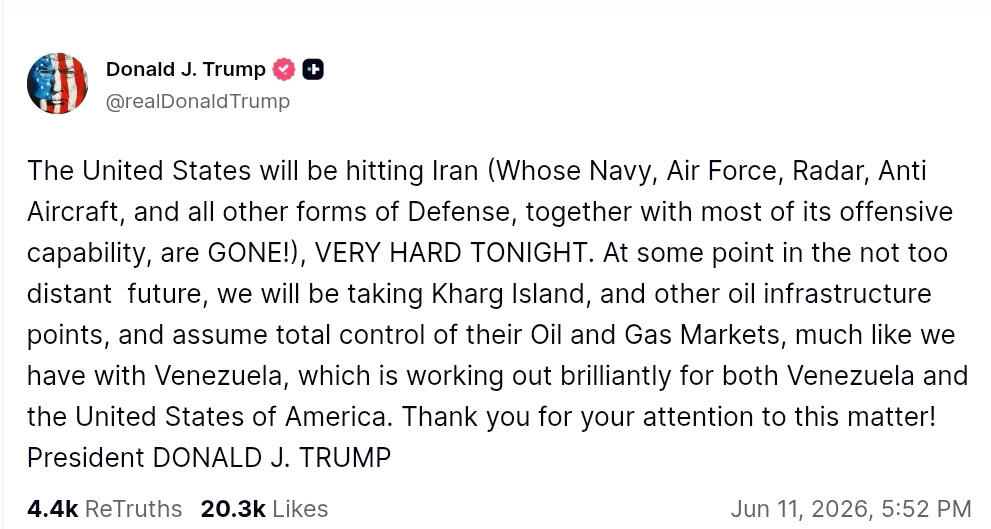
The comments came as military and diplomatic tensions continued to intensify across the Middle East.


Iran says US strikes have made ceasefire ‘practically meaningless’
Iran on Thursday said recent US military strikes had effectively nullified the ceasefire reached earlier this year, as military exchanges, diplomatic activity and maritime disruptions heightened tensions across the Middle East.
In a statement, Iran’s Foreign Ministry described the attacks as unlawful and said they had rendered the April 8 ceasefire “practically meaningless”. Tehran accused Washington of violating international law and warned that the US leadership would bear responsibility for the consequences of its actions.
The ministry later issued a separate statement condemning what it called “criminal attacks” by the United States and urged UN member states to oppose what it described as a gross violation of the UN Charter. It warned that international silence would contribute to further instability and insecurity.

Iranian Foreign Minister Abbas Araghchi raised the issue during a telephone conversation with European Union foreign policy chief Kaya Kallas, according to Tehran. Araghchi said Washington was responsible for the fallout from its recent military actions and argued that the strikes had undermined the ceasefire framework.
Gulf countries condemn Iranian attacks
The diplomatic fallout came after Iran launched missile and drone attacks targeting Bahrain, Kuwait and Jordan overnight.
Qatar, Saudi Arabia, Kuwait and the United Arab Emirates (UAE) issued separate condemnations, describing the attacks as violations of sovereignty and international law.
Qatar called for de-escalation and renewed efforts to restore regional stability, while reaffirming support for Bahrain, Kuwait and Jordan.
Saudi Arabia warned that continued attacks would deepen regional tensions and urged all parties to prioritise diplomacy. The Kingdom also stressed the importance of continuing negotiations facilitated by Pakistan alongside mediation efforts led by Qatar.
Kuwait denounced the attacks as an assault on the sovereignty and territorial integrity of neighbouring states and reaffirmed support for Bahrain and Jordan. In a separate statement, the Kuwaiti Foreign Ministry condemned attacks directed at Kuwait and asserted the country’s right to take necessary measures to defend its territory and facilities.
The UAE said the strikes represented a direct threat to the security and stability of Bahrain, Kuwait and Jordan and reiterated its solidarity with the three countries.
GCC warns against escalation
Gulf Cooperation Council Secretary-General Jassim Al-Budaiwi said repeated attacks on Gulf and Arab states posed a direct threat to regional security.
He warned that targeting civilian infrastructure undermined efforts to achieve peace and called for respect for state sovereignty and an immediate reduction in tensions. The GCC reaffirmed support for measures adopted by Bahrain, Kuwait and Jordan to protect their citizens and territory.
Bahrain and Kuwait report interceptions
Bahrain’s Defence Force said air defence systems intercepted and destroyed several incoming missiles and drones.
Authorities reported that falling debris damaged homes and vehicles in Manama and Hamad Town, while a child sustained minor injuries and received treatment. Bahraini officials accused Iran of deliberately targeting civilians and private property, describing the attacks as a violation of international humanitarian law.
In Kuwait, military authorities said hostile aerial targets were intercepted during the morning. Air traffic, which had been temporarily disrupted, later returned to normal after security assessments were completed.
Kuwait Airways said flights affected by the suspension would be rescheduled and passengers would be allowed to modify or cancel bookings without additional charges.
Indian sailors safe after MT Jalveer incident
The Embassy of India in Oman said the evacuation of crew members from MT Jalveer to Shinas port was being coordinated with support from the Royal Navy of Oman and local authorities.
Sources said all 20 Indian sailors aboard the vessel were safe. The embassy said the evacuation process was expected to be completed shortly.
Hormuz closure raises shipping concerns
Iran’s Strait of Hormuz administration announced that the strategic waterway would remain closed until further notice, citing tensions linked to US military activity in the region.
Authorities advised vessels that had already received transit permits to await further instructions before proceeding.
Despite the announcement, LNG shipments continued to move through the Gulf. According to shipping data cited by Reuters, the QatarEnergy-operated Lebrethah was heading to Pakistan, Rasheeda was approaching Southeast Asia and ADNOC-managed Marigold was en route to India. The departures increased the number of LNG cargoes that have exited the waterway since the conflict began to 12.
Diplomacy continues behind the scenes
Pakistan said communication channels between Washington and Tehran remained open through Islamabad and welcomed Qatar’s ongoing mediation efforts.
Meanwhile, CNN reported, citing a diplomatic source, that talks between the United States and Iran continued throughout the night despite the latest exchange of military strikes and remained on track.
Iran signals military readiness
A spokesperson for the Iranian Armed Forces dismissed claims that the country’s defence systems had been significantly weakened, saying Iran possessed greater military capabilities than at the beginning of the conflict.
The official said Iranian forces remained fully prepared, reiterated support for Hezbollah and suggested that Tehran retained multiple options regarding strategic waterways, including the Bab al-Mandab Strait.
Netanyahu vows continued action against Hezbollah
Israeli Prime Minister Benjamin Netanyahu said operations against Hezbollah would continue and highlighted the challenge posed by drone attacks launched by the group.
He said Israel was investing in development projects for northern communities and pledged to restore security along the country’s northern frontier.

Iran rejects shortage reports
The Iranian Embassy in India dismissed media reports claiming shortages of essential goods inside Iran.
In a statement posted on X, the embassy said supplies of basic commodities remained stable despite the conflict and external pressures. It urged journalists to rely on official and verifiable information and criticised Iran International, describing it as a politically motivated outlet that did not accurately reflect conditions inside the country.

