

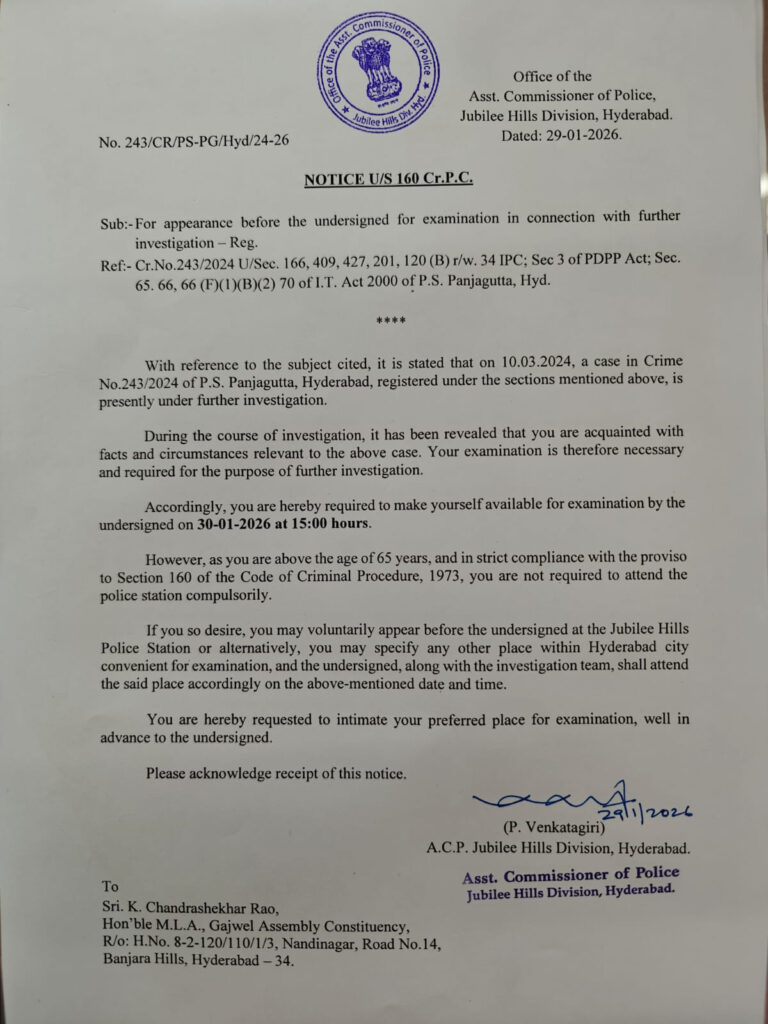
Hyderabad: Bharat Rashtra Samithi (BRS) supremo and former chief minister K Chandrashekar Rao (KCR), was on Thursday, January 29, served notice to appear before the Telangana Police Special Investigation Team (SIT) for questioning on Friday, January 30, in relation to the phone tapping case.
The nine-member SIT is being headed by Hyderabad City Police Commissioner VC Sajjanar. It was formed soon after the Congress came into power in the state.
As per the notice, KCR will be questioned at his Erravalli farmhouse in Siddipet from 3 pm onwards on Friday, instead of the Jubilee Hills police station in Hyderabad, citing his age.

BRS Working President KT Rama Rao (KTR), Siddipet MLA Harish Rao and former BRS Rajya Sabha MP Joginpally Santosh Rao have been questioned in the last two weeks in connection with the case. Both leaders called the investigation “nothing but a diversionary tactic” meant to shield administrative failures and protect Chief Minister Revanth Reddy’s position.
Details of the phone-tapping case
The phone-tapping case pertains to accusations against the BRS government of surveilling phone conversations of over 600 people, including Opposition leaders, judges, journalists, actors, and others under its ten-year rule and during the 2023 Telangana Assembly Elections. Over 1 lakh phone calls were allegedly e-tapped.
Those who were reportedly monitored included Chief Minister Revanth Reddy, members of the Bhartiya Janata Party (BJP), the Congress, and even some BRS leaders.

The case came to light soon after the Congress took over and the first FIR was lodged on March 10, 2024.
Former Telangana intelligence chief T Prabhakar Rao, the prime accused in the case, was earlier questioned by the SIT.
A suspended DSP of Telangana Special Intelligence Bureau (SIB) was among four police officials who have been arrested by Hyderabad Police since March 2024 for allegedly erasing the intelligence information from various electronic gadgets as well as for alleged phone-tapping during the previous BRS regime. They were subsequently granted bail.
 Follow on Twitter | Posted by Mohammed Baleegh | |
