

Is Urdu all about poetry, ghazals, mushairas, Ghalib, Iqbal and Faiz? To many people, the answer appears to be an emphatic yes. Urdu is often associated with lyrical verses, romantic couplets and soulful songs. The language comes alive in mushairas where audiences sway to every line and reward poets with thunderous applause. “Jahan Urdu, wahan shayeri,” goes the popular saying.
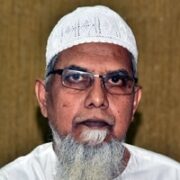
But is poetry the only identity of Urdu? Can the language also become a vehicle for science, medicine, technology and modern knowledge? Dr Abid Moiz, physician, nutritionist, writer and scholar, believes it can. Through his prolific writings, he has consistently demonstrated that Urdu possesses the ability to communicate not merely emotions but also ideas, discoveries and scientific knowledge.
Dr Moiz wants to free Urdu from the shackles of shayeri.


Adding to body of work
Author of more than 40 books on health, medicine, science, humour and language, Dr Moiz represents a rare blend of the adeeb and the tabeeb — the man of letters and the man of medicine. Long before he became a practicing physician, he had developed a deep attachment to Urdu literature. Over the decades he has successfully balanced his medical profession with his literary passion.
Recently, Dr Moiz added two more titles to his impressive body of work — “Shairi Zaria-e-Izzat Nahin” and “Istelahaat: Bojhiye aur Banaiye.” With these publications, he stands just one book short of completing half a century, a remarkable achievement for someone who refuses to confine Urdu to the world of poetry alone.
Poetry undoubtedly occupies a prestigious position in Urdu literature. Yet, Dr Moiz feels that the language suffers from an excessive dependence on verse. In many literary circles, a person is considered knowledgeable only if he can recite couplets appropriate to every occasion. The ability to quote poetry has become, in his words, a touchstone of Urdu scholarship.
He argues that while poetry enriches the language, it should not become its sole identity. Urdu, he says, is equally capable of producing literature related to medicine, science, technology, sociology and education.
The title of his book Shairi Zaria-e-Izzat Nahin is borrowed from Mirza Ghalib’s famous couplet:
Sau pusht se hai pesha-e-aaba sipahgari
Kuch shayeri zaria-e-izzat nahin mujhe
(For ages my forefathers calling was soldiering and might
I don’t seek through poetry honour and delight)
Dr Moiz uses this celebrated verse to challenge the widespread notion that recognition in Urdu can come only through poetry. According to him, excellence in medicine, science, research, translation and scholarship deserves equal respect.
Affectionate, not harsh
This book contains several essays written during his stay in Saudi Arabia where he actively participated in literary activities and organized weekend mushairas. While he enjoyed poetry and poetic gatherings, he also observed the excesses of literary culture. Through humour and satire, he gently exposes the vanity, pretensions and peculiar habits of some poets.
Articles such as “Wazan Sambhal Ke,” “Dad Talab” and “Arz Kiya Hai” are filled with wit and humour. Dr Moiz describes his approach as chedkhwani — playful teasing. His satire is not harsh but affectionate, allowing readers to laugh at the eccentricities of literary circles.
His second book, Istelahaat: Bojhiye aur Banaiye, addresses a far more serious issue: the development of scientific and technical terminology in Urdu. Modern life is dominated by science and technology. New discoveries and inventions constantly introduce fresh concepts and vocabulary. Languages survive and grow only when they can accommodate these changes. English has excelled in developing and standardising scientific terminology, while Urdu is struggling to keep pace.
Low growth of technical vocabulary
Drawing upon more than four decades of experience as a physician, nutritionist and writer, Dr Moiz emphasises the importance of terminology in education and communication. He points out that the decline of Urdu-medium education and limited employment opportunities have discouraged the growth of technical vocabulary in the language.
At the same time, many English words such as computer, internet and television have become so widely accepted that replacing them with Urdu equivalents may neither be practical nor desirable. According to him, languages must remain flexible and adopt useful terms when necessary.
This does not mean that Urdu lacks scientific vocabulary. In fact, numerous terms already exist. Examples include buland fishar-e-khoon for hypertension, falaki harkiyat for celestial mechanics and habs-e-bejaa for habeas corpus. The challenge lies not in the absence of words but in their limited usage and public familiarity.
The book also highlights the rich scientific heritage of Urdu. In earlier decades, medical textbooks and journals were regularly published in the language. Subjects such as gynecology, ophthalmology, anatomy and biochemistry found expression in Urdu works like “Ilm-e-Amraz-e-Niswan,” “Amraz-e-Chashm,” “Tashreeh-e-Badan” and “Faliyat-e-Hayati Kimiya.” Books on engineering, science and technology also appeared, proving that Urdu once possessed a vibrant intellectual tradition. The Darul Tarjuma (translation bureau) set up by the Osmania University in the late 19th century rendered many finest works of Western scholarship into Urdu.
One of the most useful sections of the book deals with word roots, prefixes and suffixes used in medical terminology. Dr Moiz explains the origins of terms connected with various organs and body parts. He discusses roots associated with bones, eyelids, glands, fingers, gall bladder and heart, providing their meanings and Urdu equivalents.
He also traces Greek roots such as phon, meaning sound, which appears in words like phonetics, symphony and telephone. Such explanations make the book valuable not only for language enthusiasts but also for students, teachers and medical professionals. There is also an informative table of abbreviations of medical and technical terms. For instance AA for Amino Acid, AI (Adequate Intake), B6 (Vitamin B-6, Pyridoxine), DM (Diabetes Mellitus), IBW (Ideal Body Weight).
Comprehensive in scope and encyclopedic in character, Istelahaat: Bojhiye aur Banaiye opens new possibilities for Urdu as a language of knowledge and scholarship.
Through these two books, Dr. Abid Moiz makes a compelling case that Urdu need not remain confined to poetry and entertainment alone. It can become a language of medicine, science, research and enlightenment.
At a time when Urdu is often viewed only through the prism of ghazals and mushairas, Dr. Moiz reminds us that a language survives not merely by celebrating its past but by preparing itself for the future.His mission clearly is to take Urdu beyond verse.