


Iranian President Masoud Pezeshkian said Israel’s continued strikes on Lebanon amount to a “flagrant violation” of the ceasefire and could undermine ongoing negotiations.
In a post on X, he said the repeated attacks were a “dangerous indicator of deceit and lack of commitment” to potential agreements, warning that continued strikes would render diplomacy meaningless and that Iran would not abandon Lebanon.
Latest updates here
Iran may limit Hormuz transit to 15 vessels a day
Iran will reportedly allow no more than 15 vessels per day to pass through the Strait of Hormuz under the ceasefire, according to Russia’s TASS news agency, citing a senior Iranian source.


The reported cap highlights continued restrictions on maritime traffic despite the truce, with the key global shipping route operating far below normal capacity.
Islamabad locked down ahead of expected peace talks
Authorities in Islamabad have sealed off a 3-km zone around the Serena Hotel Islamabad in anticipation of the first peace talks linked to the conflict.
Both US and Iranian delegations are expected to stay at the hotel, which has asked all guests to check out until Sunday after it was “requisitioned” for an “important event”.

Oil prices surge amid Hormuz uncertainty
Oil prices rose over 3 percent on Thursday as doubts over the fragile ceasefire heightened concerns that energy flows through the Strait of Hormuz will remain restricted, with shippers hesitant to resume transit.
Brent crude rose USD 3.41, or 3.6 percent, to USD 98.16 a barrel, while US West Texas Intermediate (WTI) climbed USD 4.74, or 5 percent, to USD 99.15.
UAE minister says Hormuz access remains restricted
UAE Industry Minister and ADNOC CEO Sultan Ahmed Al Jaber said the Strait of Hormuz is not fully open despite the ceasefire.
In a post on LinkedIn, he said access to the strait is being “restricted, conditioned and controlled,” adding that “conditional passage is not passage” and calling for it to remain open without restrictions to ensure global energy security.
Iran parliament speaker warns of ‘strong response’ to violations
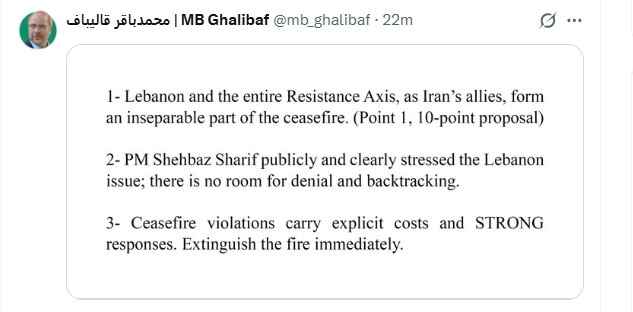
Iranian Parliament Speaker Mohammad Bagher Qalibaf warned that any violations of the ceasefire would carry “explicit costs and strong responses”, urging an immediate halt to hostilities.
In a post on X, he said continued attacks, particularly in Lebanon, risk escalating tensions and undermining fragile truce efforts, reinforcing Iran’s increasingly hardline stance amid the conflict.
Iran, Saudi foreign ministers hold first call since conflict began
The foreign ministers of Iran and Saudi Arabia held a phone call on Thursday, marking their first official contact since the start of the war.
Saudi Foreign Minister Faisal bin Farhan Al Saud received a call from his Iranian counterpart Abbas Araghchi.
In a statement on X, Saudi Arabia’s foreign ministry said the two sides reviewed the latest developments and discussed ways to reduce tensions and restore security and stability in the region.
Netanyahu confirms killing of Hezbollah leader’s aide
Israeli Prime Minister Benjamin Netanyahu confirmed that IDF strikes in Lebanon killed Ali Yusuf Harshi, the nephew and personal secretary of Hezbollah leader Naim Qassem.
In a statement on X, Netanyahu described Harshi as “one of the closest people” to the group’s leader and said the Israeli military would continue to strike Hezbollah “wherever necessary.”
He added that Lebanon is not part of the ceasefire between the United States and Iran, even as conflicting claims persist over whether the agreement extends to the country.
Israel claims Hezbollah chief’s aide killed in Beirut strike
The Israel Defense Forces (IDF) on Thursday, April 9, claimed that it has killed Ali Yusuf Harshi, the personal secretary and nephew of Hezbollah Secretary-General Naim Qassem, in a strike in Beirut.
In a post on X, the IDF said Harshi played a key role in managing and securing Qassem’s office, adding that Israeli forces also struck weapons routes, storage sites and command centres used by Hezbollah in southern Lebanon.

Lebanon moves to assert state control over weapons
Lebanon’s government has instructed security forces to ensure that all weapons in Beirut remain under the control of state institutions, a day after Israeli strikes hit multiple areas, including central parts of the capital.
According to Agence France-Presse (AFP), Prime Minister Nawaf Salam said after a cabinet meeting that the army and security forces have been asked to “reinforce the full imposition of state authority over Beirut Governorate” and ensure weapons are held only by legitimate authorities.
Spain to reopen embassy in Tehran
Spain said it will reopen its embassy in Tehran, with Foreign Minister José Manuel Albares instructing the ambassador to return and resume operations.
India issues safety advisory for nationals, seafarers in Iran
The Embassy of India in Tehran has advised Indian nationals in Iran to remain at their current locations for at least 48 hours, avoid military and sensitive infrastructure, and stay indoors.
The Directorate General of Shipping also issued a circular urging Indian seafarers in Iranian ports and waters to remain on board vessels, avoid unnecessary movement, and maintain heightened vigilance.
Seafarers and nationals have been instructed to stay in close contact with embassy officials and monitor official updates, with emergency helplines remaining operational.
Trump warns Iran of ‘bigger, better’ shooting
US President Donald Trump said American military assets will remain deployed around Iran until full compliance with the agreement is achieved.
In a post on Truth Social, Trump said: “All U.S. Ships, Aircraft, and Military Personnel… will remain in place in, and around, Iran, until such time as the REAL AGREEMENT reached is fully complied with.”
He warned that failure to comply could trigger renewed military action, stating: “If for any reason it is not… then the ‘shootin’ starts’, bigger, and better, and stronger than anyone has ever seen before.”
Trump reiterated that Iran must not acquire nuclear weapons and that the Strait of Hormuz must remain open and secure.

LPG tanker reaches Mumbai
Mumbai’s Jawaharlal Nehru Port Authority (JNPA) confirmed the arrival of an India-flagged tanker carrying 15,400 tonnes of liquefied petroleum gas.
The vessel, Green Asha, is the first such shipment to dock since the escalation of the conflict, offering some relief as supply constraints persist in several parts of India.
Strikes and ground operations expand in Lebanon
The Israeli military said it has expanded ground operations in southern Lebanon over the past week, targeting infrastructure linked to Hezbollah, killing dozens of fighters and seizing weapons and explosives.
Hezbollah said it carried out a guided missile strike on an Israeli armoured vehicle in Taybeh and launched a drone attack on Israeli forces inside a building, claiming direct hits.
Heavy bombardment in Beirut raises civilian toll
Israeli airstrikes hit densely populated commercial and residential areas in Beirut shortly after the ceasefire announcement, killing and injuring large numbers of civilians.
Hospitals have been overwhelmed, issuing urgent appeals for medical staff, while rescue teams continue to search for survivors under rubble.
Iran accuses Israel of ceasefire violations
Iran’s deputy foreign minister told BBC that Israeli strikes in Lebanon constitute a serious violation of the ceasefire.
Tehran has called on regional countries to adhere to the agreement and urged Washington to ensure its allies comply. Iran’s parliamentary speaker is expected to lead a delegation for talks, with communication continuing via Pakistan.
Diplomatic activity and regional reactions
- Pakistan condemned Israeli strikes on Lebanon and called for urgent international action
- Pakistan and Saudi Arabia stressed the need to fully implement the Washington–Tehran agreement
- Iran’s ambassador to Pakistan said a delegation would travel to Islamabad for talks based on a 10-point peace plan, though an earlier announcement of the visit was later removed
Western powers call for restraint
The United Nations Secretary-General António Guterres condemned civilian casualties and warned of risks to peace efforts.
France urged Iran to abandon nuclear ambitions and halt missile and drone use, while the United Kingdom called for extending the ceasefire to include Lebanon and stressed that the Strait of Hormuz must remain a free trade route.
Strait of Hormuz disruptions deepen
Shipping through the strategic waterway remains severely constrained:
- Hundreds of vessels are stranded, including around 426 oil tankers and 53 gas carriers
- Only a handful of ships have crossed since the ceasefire
- Reports suggest Iran is requiring advance transit payments in cryptocurrency
- The United States is seeking commitments from European allies to secure navigation
- Two Chinese oil tankers are positioned near the strait awaiting safe passage
Conflicting signals over ceasefire and negotiations
Israeli media reported that Prime Minister Benjamin Netanyahu opposed the agreement with Iran in a call with Trump prior to its announcement.
Iranian military officials said accepting a ceasefire and entering negotiations represents a victory, but warned that the US cannot be trusted based on past agreements.
Differences remain over Iran’s nuclear programme, with Washington insisting on halting uranium enrichment, while Iranian officials say enrichment can continue under the deal.
Casualties and humanitarian impact
Israel’s health ministry said more than 7,400 people have been injured since the start of the conflict, with about 118 still receiving treatment.
In Lebanon, large-scale destruction has displaced families, with entire neighbourhoods reduced to rubble and emergency services stretched beyond capacity.
Energy markets and global impact
Oil prices rebounded sharply after a steep fall, with Brent crude rising above USD 97 per barrel and US crude nearing USD 98, amid continued uncertainty over the Strait of Hormuz and regional stability.

