
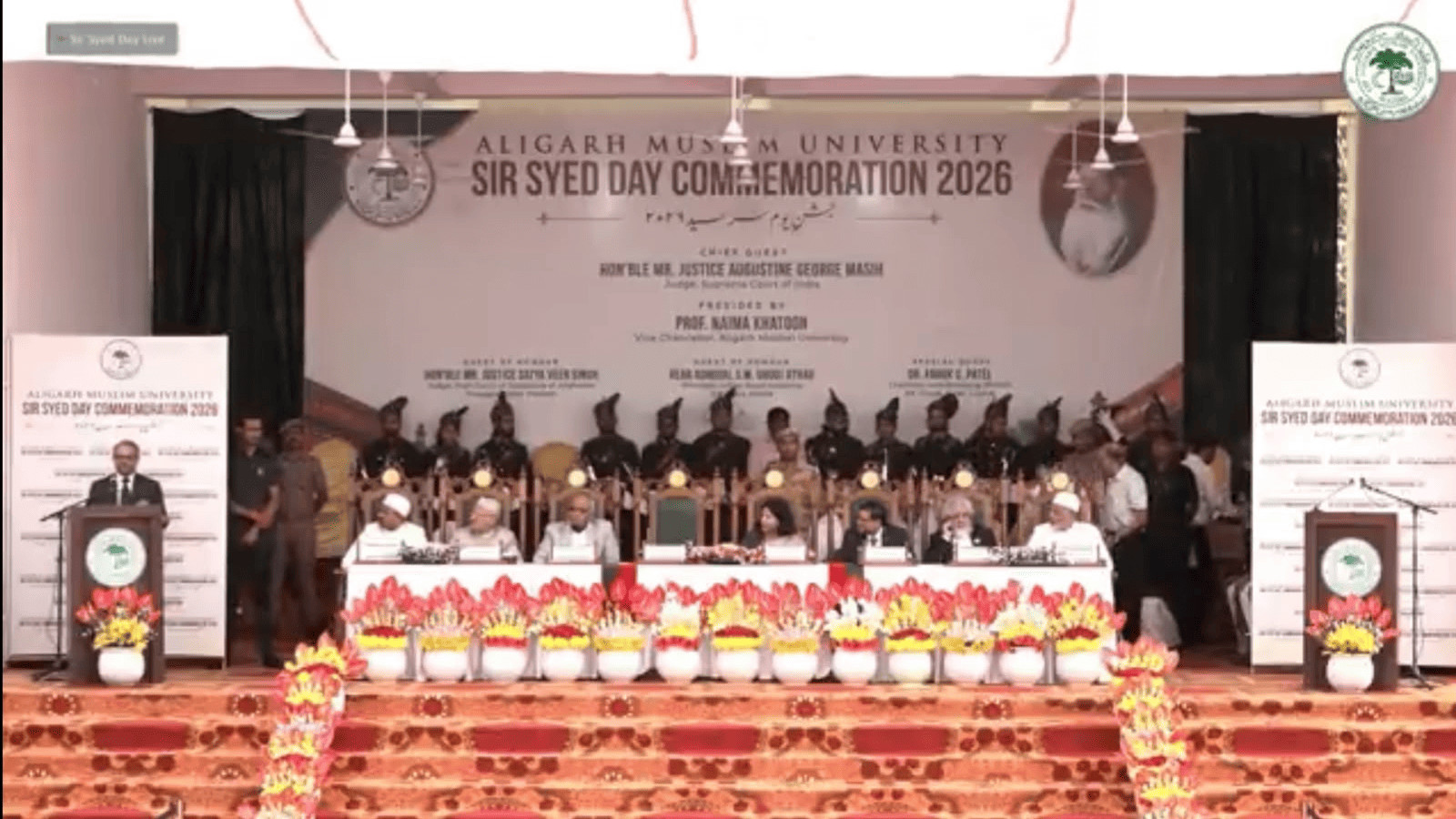
Some men leave behind monuments of stone. A rare few leave behind a vision that shapes generations. Sir Syed Ahmed Khan belongs to the second category.
October 17 marks the 209th birth anniversary of Sir Syed Ahmed Khan, the educationist who sought to transform Indian society through modern education, scientific inquiry and democratic dialogue. Born in Delhi in 1817, when the Mughal Empire was in decline, he came from a family whose forebears had served the Mughal court. He joined the East India Company’s service in 1837-38 and retired in 1876 as a Judge of the Small Causes Court.
A turning point came in 1855, when Sir Syed approached Mirza Ghalib for a foreword to his critical edition of Abul Fazl’s Ain-i-Akbari. Ghalib advised him to look beyond the past towards the possibilities offered by contemporary British civilisation. Sir Syed increasingly engaged with European literature, education and scientific thought, seeking ways to advance Indian society while remaining rooted in his religious beliefs. He even wrote a commentary on the Bible.


While posted at Ghazipur, he established Victoria High School in 1863-64, describing it as an effort to foster brotherhood among his countrymen. He also advocated greater Indian representation in legislative bodies. His interest in European science and technology, and his conviction that Muslims had declined by neglecting the rationalist traditions of their own Golden Age, led him to establish the Scientific Society to translate European works on arts and sciences into Indian languages.
The Revolt of 1857 and its aftermath
During the Revolt of 1857, Sir Syed was posted as Sadr Amin in Bijnor, where he saved the lives of several British officers. The experience prompted him to examine the causes of the uprising. In Asbab-e-Baghawat-e-Hind (The Causes of the Indian Revolt), he argued that the East India Company’s failure to understand public sentiment and include Indians in governance had contributed to the revolt.
His political outlook developed alongside his engagement with liberal ideas, particularly during the tenures of British Prime Ministers William Gladstone and Viceroys Lord Ripon and Lord Dufferin.
A transformative journey to England
On April 10, 1869, Sir Syed sailed from Bombay for England with his sons, Syed Hamid and Syed Mahmood. The latter had received a government scholarship to pursue higher education there.
Arriving in London on May 4, Sir Syed met prominent political figures, historians and intellectuals, including the Duke of Argyll, Thomas Carlyle and Charles Dickens. He was struck by the educational advancement of Victorian society. Even domestic servants and coachmen read newspapers, while English women had access to reading and education — opportunities largely denied to women in even elite Indian families.
He came to believe that mass education was essential for Indians to attain social advancement and recognition. Visits to Oxford and Cambridge further strengthened his resolve to establish an institution that combined modern learning with cultural rootedness.
The birth of MAO College
Establishing such an institution was no easy task. Funding was a major challenge, while sections of the conservative Muslim elite feared that modern education would alienate students from their faith. Sir Syed faced opposition from orthodox clerics, including those who denounced him as a heretic, but he persisted with his mission.
With contributions from Indian nobles, landlords and other supporters, along with backing from the British government, the Muhammadan Anglo-Oriental (MAO) College was established in Aligarh in 1877, having begun as Madrasat-ul-Uloom Musalmanan-e-Hind in 1875. At its foundation ceremony, Viceroy Lord Lytton described the institution as an epoch in India’s social progress.
The college’s early principals, Henry George Impey Siddons, Theodore Beck, and Theodore Morison, helped shape its development. Sir Syed also established a common mosque for Sunni and Shia students, reflecting his commitment to coexistence.
He did not live to see the college become a university. However, after he died in 1898, his supporters continued the campaign, eventually leading to the establishment of Aligarh Muslim University (AMU) in 1920. The Begum of Bhopal, Sultan Jahan, became its founding chancellor, the first woman head of any modern university. AMU carried forward Sir Syed’s vision of combining modern education with cultural identity. Sir Hamilton Gibbs, a noted orientalist, called AMU the “first modernist institution in Islam”.
The Students’ Union and Sir Syed’s democratic legacy
Sir Syed was deeply influenced by the culture of parliamentary debate at Oxford and Cambridge. Seeking to foster similar democratic dialogue in India, he founded the Siddons Union Club at MAO College, named after its first principal. The initiative was an early attempt to encourage debate and deliberation in a colonial society where representative government remained limited.
The club eventually evolved into the AMU Students’ Union, which became an integral part of campus life and produced generations of political leaders and public figures.
Sir Syed’s emphasis on rational inquiry also resonates with Article 51A(h) of the Constitution, which makes it a fundamental duty of citizens to develop scientific temper, humanism, and the spirit of inquiry and reform.
The recent protest at AMU demanding restoration of the Students’ Union, a demand subsequently accepted by the university administration, thus echoes values embedded in Sir Syed’s legacy. His vision extended beyond classrooms: it sought to cultivate informed citizens capable of reasoned debate, social progress and democratic participation.
More than a century after his death, Sir Syed Ahmed Khan’s enduring contribution lies not merely in founding an institution but in championing an idea — that education, scientific inquiry and democratic dialogue can transform generations.
(The article has been authored by Aman Alam and Ramisha Fatima. Alam is a Barrister at the University of London and an advocate in the Supreme Court of India. Fatima is a third-year law student at Aligarh Muslim University.)
 | |

