

Hyderabad: Secunderabad was once built with wide, orderly roads – a legacy of its military-planned past. Walk through it today and that order is gone. Footpaths across the city’s main roads and neighbourhoods have collapsed under neglect. Pedestrians are pushed off the kerb and onto the road, because footpaths here are treated as dumping grounds, parking spaces or free space for anyone to use.
Take the footpath outside the fenced compound on Entrenchment Road. On paper, it is a good one. Red and grey interlocking tiles, a painted kerb, tactile strips for the visually impaired. It runs for only a few metres before a tree trunk grows out of the middle of it, and a little later it disappears under a mound of construction rubble, torn tarpaulin and garbage piled against the compound wall.
A discarded mattress and a folded quilt lie on a clean stretch of the same pavement a few hundred metres away. Somebody sleeps here. Nobody walks here.



This is the pattern across Secunderabad, according to a survey by Siasat.com from East Marredpally to the railway station, through Tarnaka and out to Yapral. The Indian Roads Congress requires a clear, unobstructed walking width of 1.8 metres in residential stretches and 2.5 metres in commercial ones. Of the dozen-odd stretches covered, not one held that width for a continuous hundred metres.
“Secunderabad footpaths are a joke. As you can see around, there is nothing for us to walk on. It is exhausting going up and down a footpath due to obstructions. I have no hope that the authorities will fix this,” said Praveen, a resident of East Marredpally for the last 40 years.
East and West Marredpally: No room for footpaths
Marredpally could have had some of the better-laid footpaths in Secunderabad. It also shows most clearly how little that matters.

In West Marredpally, the stretch outside Optic Corner and Bhavani Medical Stores is tiled and level. It is also lined end to end with parked two-wheelers, leaving pedestrians a gap of a few inches between the bikes and the shopfront.

A little ahead, near Sweet Basket and Excellencia Junior College, scooters are parked along the entire frontage while students walk in the traffic lane beside them.

The footpath near the Sarvasukhi Colony junction has been dug up and left that way – loose tiles, a sand heap and a length of exposed cable where the walking surface should be.

Outside a row of shuttered shops, construction debris, cement sacks and a discarded tarpaulin have been dumped and simply left. Near the court lane, vendors selling stamp papers operate from tables set up on the pavement, under tarpaulin sheets tied to trees.

In East Marredpally, the meat and poultry row near 2nd Lami Nagar has no usable footpath at all. Shop frontages, display boards, delivery bikes and customers occupy the full width up to the tar.

Outside St Mark’s High School, the entire pavement is a parking lot for students’ bicycles and staff two-wheelers.

“We walk on the road holding the child’s hand, there’s no other way,” a parent who had come to pick his son up from school told Siasat.com.
Ravi Reddy, an elderly man with a walking stick, was picking his way along the road edge. “This has always been the case in Marredpally. I am used to it now,” he said.
Where pavement becomes a service lane
On Sarojini Devi Road, one of Secunderabad’s busiest commercial areas, the footpath near the Medicover Hospital junction is wide and tiled. It is also blocked off with wooden sticks, presumably by the hospital itself. A security cabin and a leaning electricity pole take up what is left.


Outside Yashoda Hospital nearby, there are no footpaths for the hundreds who come for treatment. The boundary is blocked by traffic cones to stop cars from parking, pushing pedestrians onto the road.
Further along, three GHMC garbage bins stand mounted on a steel frame on the pavement. All three were overflowing, the waste spreading across the tiles and into the road. A coconut water vendor’s cart occupied the remaining width, its owner seated on the kerb beside a sack of husks.

“I have been selling coconut water here since the last eight years. I have nowhere else to go,” the female vendor, who did not want to be named, said. Asked why she was blocking the footpath, she acknowledged the problem but added, “I have to do it to feed my family. What else can I do?”
Outside the coaching institutes near the Clock Tower, the footpath has been given over to autorickshaw drivers waiting for customers, parked two-wheelers and two carts selling tempered glass for mobile phones. Students and commuters walk around them, directly on the road, as vehicles move past.
“If I move back, no customer sees me,” said the vendor selling tempered glass.
At Secunderabad Railway Station, the footpath is the market
The approach to Secunderabad Railway Station has no usable pedestrian infrastructure. Outside the Swathi Lodge and Asoka Restaurant block, fruit sellers had laid out pomegranates and sweet limes on crates along the footpath, a belt-seller had hung his stock on the steel pedestrian railing itself, and two umbrella stalls closed off the last gap. The railing, installed to keep people off the road, had become a display rack.
Not just vendors – a GHMC Indiramma Canteen container sits on the footpath, drawing a queue that spills onto the road at meal times. Adding to the chaos is the volume of buses, taxis and autos outside the station, with the footpath the only lifeline for anyone on foot.

“It is so difficult to walk to the station, especially if you have luggage and are using the bus. All the vendors and the food outlets block it. This is a high-density area. They should just clear it,” said Saptarishi Ghosh, hurrying to catch a train to Kolkata.
The army area with almost no footpaths
One might expect the Secunderabad Cantonment, governed by a military board, to be strictly bound by footpath regulations. Yet pedestrian infrastructure remains an afterthought.
Along the major routes cutting through the Cantonment towards Yapral and Sainikpuri, the roads are smooth for motorised traffic, but the edges are dusty, unpaved strips of mud. When it rains, these turn to slush. The absence of raised kerbs also means vehicles frequently swerve close to those on foot.

At Tarnaka, a footpath under a Metro line
Tarnaka has had years of infrastructure spending. The Metro viaduct runs overhead, the junction has been rebuilt and the arterial road is wide. The footpath under all of it is still not walkable for long.
Outside Karachi Bakery and the Linen Club showroom, the tiled pavement is in reasonable condition – and cordoned off with traffic cones and plastic tape by the shops themselves, apparently to stop vehicles from parking. Pedestrians walk around the cones, on the road.

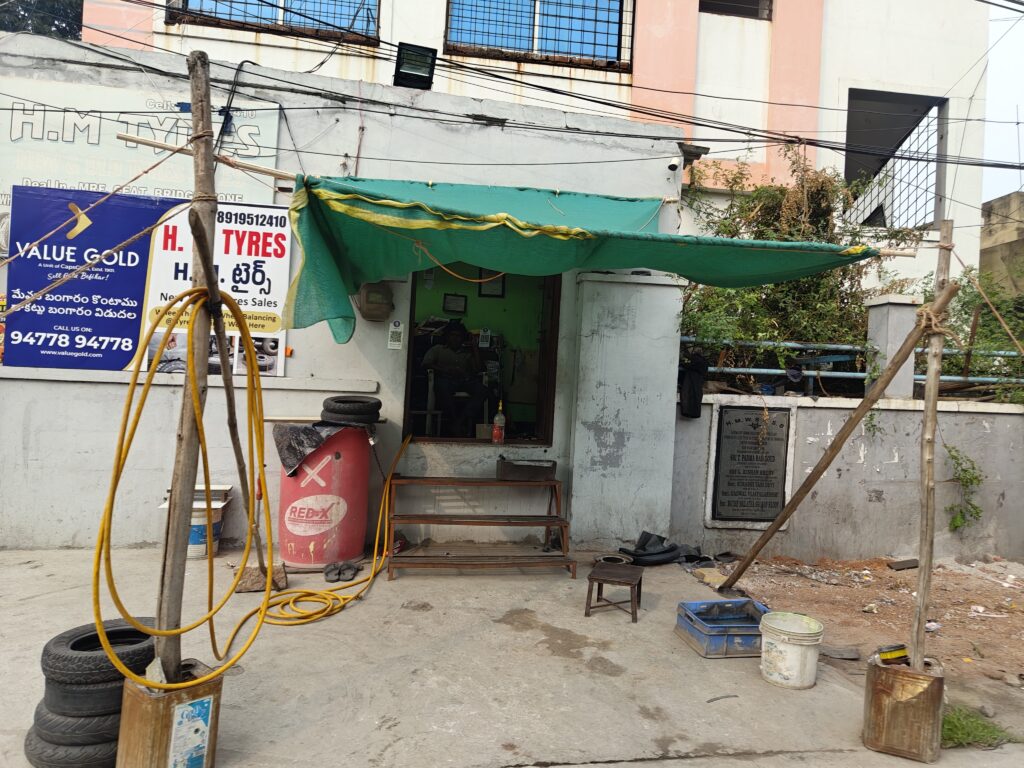
Near Tapadia Diagnostic Centre, the footpath narrows to a strip between the compound wall and a cluster of utility poles, with a mesh of low-hanging cables. Outside HM Tyres, used tyres, an air hose and a workbench are arranged across the pavement, which functions as the workshop floor.

On the Lalapet side, it is worse. Outside AK Bike Point, motorcycles under repair are parked across the full width of the footpath. Next door, a tent house uses the frontage to stack crockery and folding furniture. A stretch near Krishna Reddy Sweets is broken concrete and loose gravel.
“They built the Metro over our heads and forgot the ground,” said Suresh, a resident of the area for 30 years.


At Osmania University, a footpath too narrow to use
The road along the Osmania University boundary wall has one of the longest continuous footpaths in the area, with large stretches unavailable to walk on. For close to a kilometre, it functions as an open-air market – secondhand clothes spread along the kerb, wall clocks laid out in their cardboard boxes on the tiles.


“We have to walk in a single straight line whenever we use the footpath. It just isn’t wide enough even for two people,” said Ashrita, a second-year BSc student, walking outside the English and Foreign Language University (EFLU).
Out in the new suburbs, there is nothing to encroach
North of the Cantonment, the problem changes shape. In Yapral, outside a furniture workshop on the main road, sofas, bed frames and a kitchen cabinet stood on what would have been the pedestrian zone. There was no footpath under them.

Where the big apartment complexes begin, however, the footpaths are wide, clean and well maintained. Step outside that pocket and they are practically non-existent.
“There are footpaths here. I walk here every evening. I know that most of Yapral doesn’t have footpaths, but here we do. I am satisfied,” said Pallavi Sai, a resident of Om Sree Heights.

In Kowkoor, an old row of kirana stores and a tent house open straight onto a strip of sand. At AS Rao Nagar, outside the Axis Bank and Aruna Diagnostics building, the space between the shops and the road is bare dirt, used entirely for parking two-wheelers.
These are among the fastest-growing residential pockets in GHMC’s northern areas, with new apartment blocks going up on every second plot.


Sainikpuri is the exception
In Sainikpuri‘s numbered avenues, laid out decades ago as planned housing for service families, the footpaths are intact, usable and clean.
Even along the main road, where there are several commercial establishments, they are wide enough that hawkers and vehicles have not taken them over.

(This is part 5 in a six-part series focusing on Hyderabad’s footpaths and pedestrian infrastructure. Click to read part 3 and part 4)
 |
| 
