
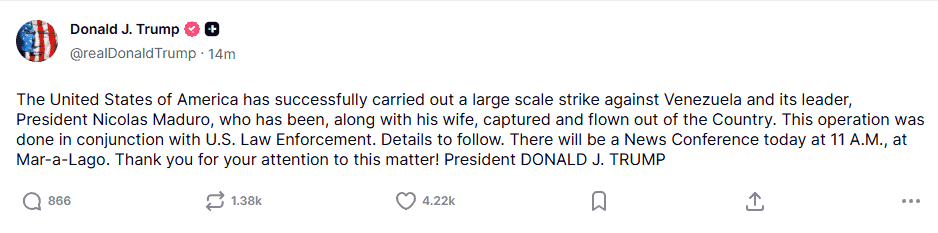
Caracas: Venezuelan President Nicolas Maduro has been captured and flown from the country, President Donald Trump announced early on Saturday after confirming that the US forces conducted what he called “a large-scale strike against Venezuela and its leader.”
In a post on social media, Trump said Maduro’s wife was also seized in the operation conducted along with US law enforcement. Trump said he planned to deliver a statement later Saturday morning.
Vice-President demands Maduro’s proof of life
Venezuela’s vice president has appeared on state TV to say that the government doesn’t know where the president and his wife are after U.S. forces captured them.


“We do not know the whereabouts of President Nicolás Maduro and First Lady Cilia Flores,” Delcy Rodriguez said. “We demand proof of life.”
At least seven explosions and low-flying aircraft were heard around 2 am local time on Saturday, January 3, in Caracas, the capital of Venezuela, with President Nicolás Maduro declaring a national state of emergency.
The Venezuelan government accused the United States of attacking civilian and military installations in multiple states. “The Bolivarian Republic of Venezuela rejects, repudiates, and denounces before the international community the extremely serious military aggression perpetrated by the current Government of the United States of America against the Venezuelan territory,” the government said.

The statement added that President Maduro had “ordered all national defence plans to be implemented” and declared “a state of external disturbance.”
Additionally, Defence Minister Vladimir Padrino said that Venezuela will resist the presence of foreign troops in a video after the attack. He added that Venezuela is compiling information about dead and injured people.
US Senator Mike Lee, R-Utah, posted on X that Secretary of State Marco Rubio had briefed him on the strike and said that Maduro “has been arrested by U.S. personnel to stand trial on criminal charges in the United States.”
World leaders react
Colombia prepares to receive refugees from Venezuela
President Gustavo Petro of Colombia, one of Trump’s fiercest critics, said the Colombian government convened a national security meeting before dawn Saturday and sent security forces to the border in preparation for a potential “massive influx of refugees” from neighbouring Venezuela.
He said he’d also call on the UN Security Council to consider “the aggression against the sovereignty of Venezuela and of Latin America.”
“Without sovereignty, there is no nation,” Petro wrote on social media.
Russia calls US action an act of armed aggression
Russia’s Foreign Ministry condemned what it called a US “act of armed aggression” against Venezuela in a statement posted on its Telegram channel Saturday.
“Venezuela must be guaranteed the right to determine its own destiny without any destructive, let alone military, outside intervention,” the statement said.
The ministry called for dialogue to prevent further escalation and said it reaffirmed its “solidarity” with the Venezuelan people and government, adding that Russia supports calls for an emergency UN Security Council meeting.
State Department urges Americans in Venezuela to shelter in place
The State Department issued a new travel alert early Saturday, warning Americans in Venezuela to “shelter in place” due to the situation.
“US Embassy Bogota is aware of reports of explosions in and around Caracas, Venezuela,” it said without elaboration.
“The US Embassy in Bogota, Colombia, warns US citizens not to travel to Venezuela. US citizens in Venezuela should shelter in place.” The embassy in Bogota has been shuttered since March 2019 but operates remotely.
Secretary of State Marco Rubio retweeted Trump’s announcement without comment, but his deputy, Christopher Landau, posted Trump’s statement, adding that it marked “a new dawn for Venezuela!” “The tyrant is gone. He will now—finally—face justice for his crimes,” Landau said.
Meanwhile, the Federal Aviation Authority has banned US commercial flights in Venezuelan airspace over “ongoing military activity” ahead of explosions in Caracas.
Venezuelan government calls on supporters to protest
Venezuela’s government, in their statement, called on its supporters to take to the streets.
“People to the streets!” the statement said. “The Bolivarian Government calls on all social and political forces in the country to activate mobilisation plans and repudiate this imperialist attack.”
Calling the move an “imperial aggression,” the government stated that the people of Venezuela will “rise up once again to defend their independence.”
Explosions heard near military bases
Smoke could be seen rising from the hangar of a military base in Caracas. Another military installation in the capital was without power.
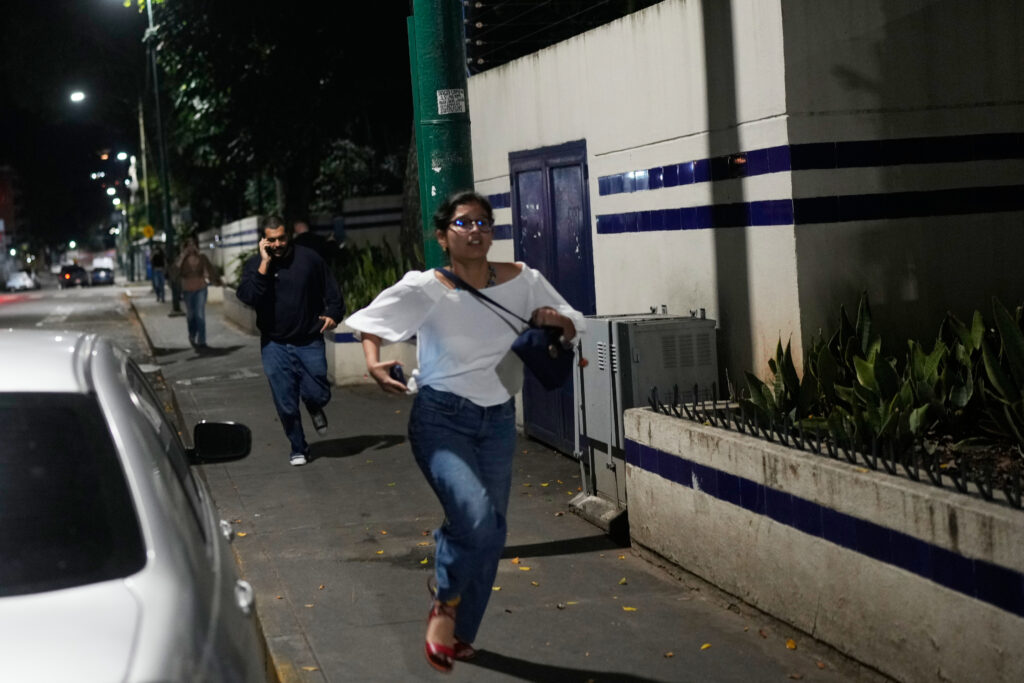
People in various neighbourhoods rushed to the streets. Some could be seen in the distance from various areas of Caracas.
“The whole ground shook. This is horrible. We heard explosions and planes,” said Carmen Hidalgo, a 21-year-old office worker, her voice trembling. She was walking briskly with two relatives, returning from a birthday party. “We felt like the air was hitting us.”
What triggered the strikes?
This comes as the US military has been targeting, in recent days, alleged drug-smuggling boats.
On Friday, January 2, Venezuela said it was open to negotiating an agreement with the United States to combat drug trafficking.
The South American country’s President Maduro also said in a pre-taped interview aired on January 1 that the US wants to force a government change in Venezuela and gain access to its vast oil reserves through the monthslong pressure campaign that began with a massive military deployment to the Caribbean Sea in August.
Maduro has been charged with narco-terrorism in the US. The Central Intelligence Agency (CIA) was behind a drone strike last week at a docking area believed to have been used by Venezuelan drug cartels in what was the first known direct operation on Venezuelan soil since the US began strikes on boats in September.
US President Donald Trump for months had threatened that he could soon order strikes on targets on Venezuelan land. The US has also seized sanctioned oil tankers off the coast of Venezuela, and Trump ordered a blockade of others in a move that seemed designed to put a tighter chokehold on the South American country’s economy.
US had attacked at least 35 boats ‘carrying drugs’
The US military has been attacking boats in the Caribbean Sea and the eastern Pacific Ocean since early September. As of January 2, the number of known boat strikes is 35, and the number of people killed is at least 115, according to numbers announced by the Trump administration.
They followed a major buildup of American forces in the waters off South America, including the arrival in November of the nation’s most advanced aircraft carrier, which added thousands more troops to what was already the largest military presence in the region in generations.
Trump has justified the boat strikes as a necessary escalation to stem the flow of drugs into the United States and asserted that the US is engaged in an “armed conflict” with drug cartels.
Meanwhile, Iranian state television reported on the explosions in Caracas on Saturday, showing images of the Venezuelan capital. Iran has been close to Venezuela for years, in part due to their shared enmity of the US.