


Hyderabad: Every August 29, India celebrates National Sports Day, the birthday of Major Dhyan Chand who played hockey for India at the Olympics in 1928, 1932 and 1936 and won gold all three times. People called him the wizard, and the day named after him has become the country’s yearly moment to ask how Indian sport is doing.
In eight months since the year began, India has defended a World Cup at home, won more boxing gold at the Commonwealth Games than any country ever has and taken its first ever gold in Commonwealth para athletics.
Here are the highlights of Indian sports in 2026 so far.


Ahmedabad, March 8
The year will be remembered first for one Sunday evening at the Narendra Modi Stadium.
New Zealand won the toss and chose to bowl. It was the last thing that went their way. Sanju Samson hit 89 off 46 balls and Abhishek Sharma 52 off 21, and between them they took 92 runs off the first six overs, the highest opening burst of the tournament. Ishan Kishan came in and made 54 off 25.
The final score, 255 for five, is the highest any team has made in a T20 World Cup final.

The 96-run win made Suryakumar Yadav’s team the first to win three T20 World Cups, the first to win it twice in a row, and the first to win it at home. For the 86,824 people in the ground, it also made up for the 2023 one-day final India lost in the same stadium. Samson finished as player of the tournament with 321 runs.
The world stage of Glasgow
The Commonwealth Games, held from July 23 to August 2, were a stripped-down edition. Five sports India usually relies on for medals, such as wrestling, badminton, table tennis, hockey and shooting, were not on the programme at all.
India still finished fourth, with 39 medals, with 13 gold, 17 silver and nine bronze. Australia topped the table with 62 golds, ahead of England with 26 and Canada with 18. Considering what was missing from the schedule, fourth place was better than it looks.
Boxing: 7 golds and a record nobody has matched
Ten medals, seven of them gold. No country has won that many boxing golds at a single Commonwealth Games. Ten of India’s 14 boxers reached their finals.
Jaismine Lamboria, already the world champion after Liverpool last September, outpointed the defending champion Michaela Walsh of Northern Ireland at 57kg. Sakshi Chaudhary used her reach to keep England’s Ruby White at arm’s length in the 51kg final and won on all five judges’ cards.
Priya Ghanghas came through a swinging 60kg bout against Canada’s Marie-Bathoul Al-Ahmadieh by taking the last round. Preeti Pawar won at 54kg and Arundhati Choudhary at 70kg, the latter against England’s Chantelle Reid in a cagey final between the world’s second and fifth ranked boxers.
Sachin (60kg) and Ankush (70kg) took the men’s titles. Lovlina Borgohain settled for silver at 75kg, as did Jadumani Singh and Narender Berwal. Lamboria carried the flag at the closing ceremony.
Weightlifting: 7 medals from eight events
Mirabai Chanu provided the gold. Lifting in the 48kg class, she managed 85kg in the snatch and 105kg in the clean and jerk for a total of 190kg, breaking the Games record in both lifts and in the total. She missed her first attempt at 105kg, went back and got it the second time and finished 22kg clear of the field.

It was Mirabai’s third Commonwealth title in a row and her fourth medal at the Games, making her the second Indian woman after Vinesh Phogat to win gold at three straight editions.
Harjinder Kaur, in the 69kg class, worked her way up, first with 95kg, then 99kg, then 101kg and finally added 126kg in the clean and jerk for 227kg. It was silver, behind Canada’s Charlotte Simoneau, but a clear improvement on the bronze she won in Birmingham four years ago.
Rishikanta Singh, Muthupandi Raja, Gyaneshwari Yadav and Valluri Ajaya Babu also took silver, while Bindyarani Devi won bronze.
Athletics: 10 medals and a runner who came back for a second
Gulveer Singh ran his 10,000m in heavy Glasgow rain. He sat with the lead pack, went through 3000m in 8:39.2, slipped to fifth by 6,000m, worked his way back to third by the bell and then produced the finish of his life on the last lap. He clocked 27:49.78, less than a second behind Australia’s Ky Robinson. It was the first Commonwealth medal an Indian had won in the event and it came in a race Kenya and Uganda did not medal in at all.

Four days later he did it again in the 5,000m, moving from fifth to third on the final lap and holding off Kenya’s Cornelius Kemboi by four-hundredths of a second. No Indian track and field athlete had won two individual medals at a single Games before.
Neeraj Chopra was back at the Commonwealth Games after missing the last one with an injury. Throwing into a strong headwind, he managed 85.83m for silver. His last three attempts brought 80.73m and two fouls. Sri Lanka’s Rumesh Tharanga Pathirage won it with 89.75m, the only legal throw he produced in six attempts, and Sri Lanka’s first athletics gold at these Games.

Yash Vir Singh, at his first Games, was sitting outside the medals until his final throw, which went out to a personal best 85.41m for bronze. Arshad Nadeem, the defending champion, managed 77.41m and was eliminated after three rounds.
Sarvesh Kushare gave India its first athletics medal of the Games in the high jump. He cleared every height up to 2.25m without fuss, the same height as the winner, Jamaica’s Romaine Beckford, but had needed one attempt more along the way, and that put him second.
Tejaswin Shankar, who gave up the high jump for the decathlon after Birmingham, took bronze and became India’s first Commonwealth decathlon medallist. Murali Sreeshankar won long jump silver for the second Games running. Praveen Chithravel, who had missed a medal by three centimetres in Birmingham, jumped 16.58m for silver in the triple jump, with debutant Selva Prabhu Thirumaran taking bronze on 16.52m.
Seema Kaliramna won bronze in the discus.
Judo: The first golds after 36 years
India had won judo medals at every Commonwealth Games since the sport was introduced in 1990 and had never won gold. On one Friday in Glasgow, it won two.
Asmita Dey went first, in the women’s 48kg final against Canada’s Heidi Quach. Quach threw her midway through for the lead. Dey, already carrying a penalty, threw straight back to level it and the bout went into golden score, where she found the score that won it. The 23-year-old from Belonia in Tripura, the daughter of a bicycle repair shop owner, had started out as an 800m runner.
Minutes later, Harsh Singh, also 23 and at his first Games, beat Australia’s Joshua Katz in the men’s 60kg final. Katz is an Olympian, a four-time Oceania champion and a Birmingham bronze medallist. It was a tight, tactical fight until Harsh landed a waza-ari with 41 seconds left and defended it out.
Yamini Mourya added silver at 57kg, losing a final that ran almost seven minutes to England’s Acelya Toprak. Unnati Sharma, beaten in the 63kg semi-final by Australia’s Saya Middleton, came back for the bronze bout and threw South Africa’s Skye Knoester for ippon in a minute and seven seconds.
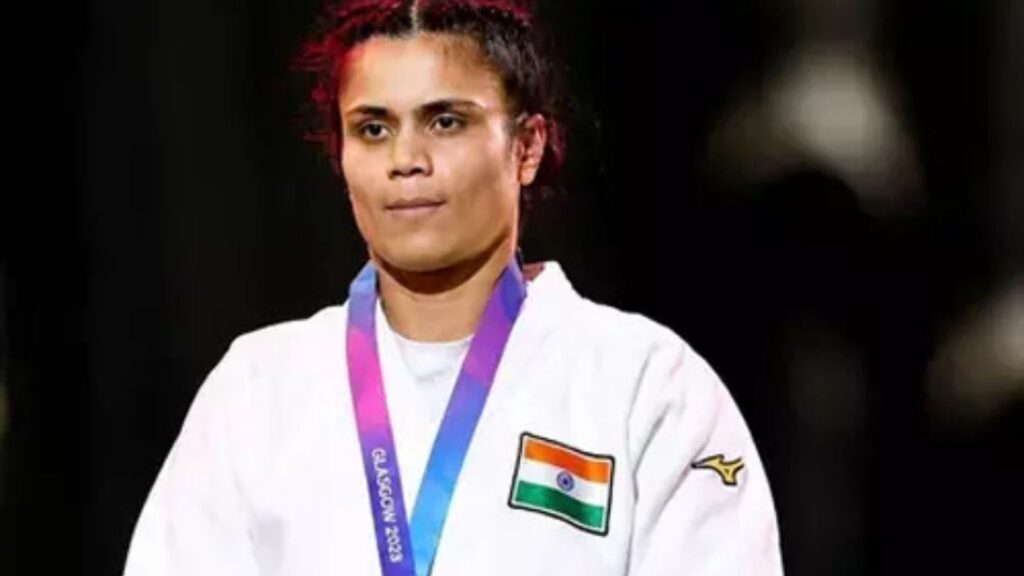
Four medals in all, India’s best return in the sport.
Para athletes: 7 medals and a 20-year wait ended
Sharmila Dhankar threw 9.81m, her best of the season, to win the women’s shot put F57, a class in which athletes throw from a seated position. It was India’s first Commonwealth gold in para athletics and the country’s first medal in the discipline since Ranjith Kumar Jayaseelan’s bronze in 2006.
She was not alone on the podium. Shilpa K Shyla thought she had finished just outside the medals in the same event, until a review invalidated the only legal throw by Nigeria’s Eucharia Njideka Iyiazi and moved Shilpa up to bronze, making it India’s first double podium in a para athletics event at these Games.
There was a second one in the men’s 100m T47, a class for runners with an arm impairment, where Dilip Gavit won gold and Mohammed Basil M took silver. Soman Rana threw 13.40m to win the men’s shot put F57, with Shubham Juyal second on 13.28m. Jhandu Kumar had opened India’s account at the Games with bronze in para powerlifting.
Seven medals in total, as many as India’s para athletes had won at every previous Commonwealth Games put together.
What the day is really for
National Sports Day is not only about medals. It is also the government’s yearly reminder that the point of all this is to get more people playing.
Even so, the Commonwealth flag left Glasgow in Indian hands. Ahmedabad hosts the Games in 2030, their hundredth year, and Neeraj Chopra and PT Usha were on stage to receive it. Dhyan Chand’s day has usually been about looking back.
This year there is plenty to look forward to.
(Additional reporting by Zaheer Hasan)