


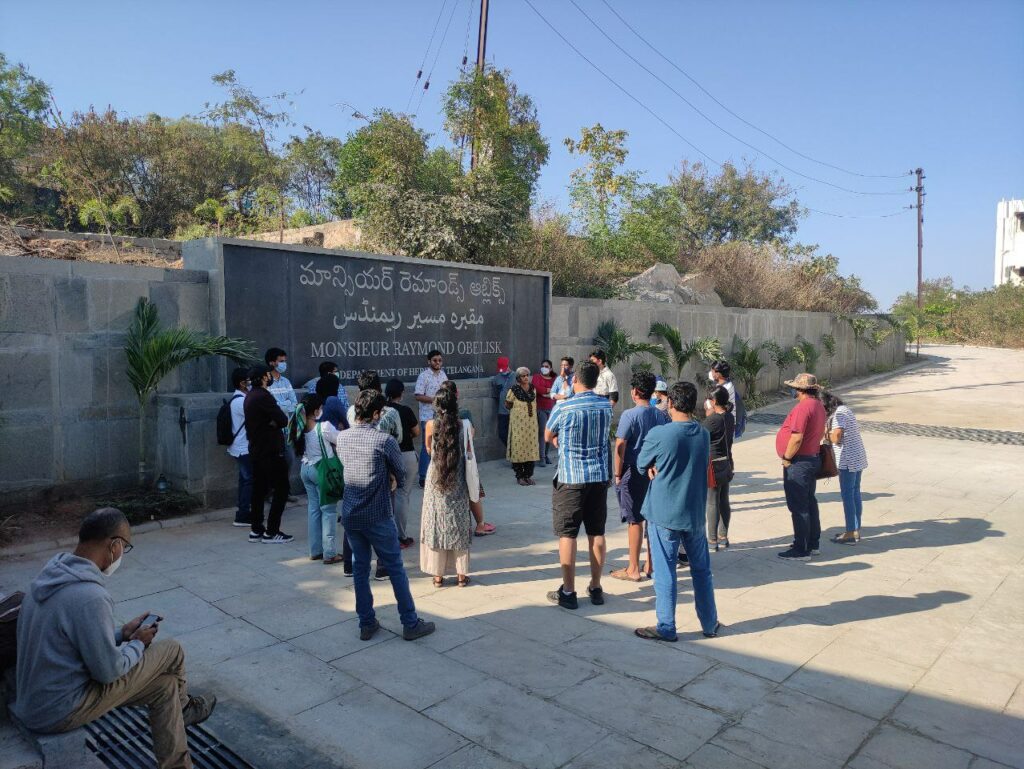
Hyderabad: It may be difficult to imagine a French-speaking Hyderabad instead of English, but for a short while in the 18th century that was a plausibility had one person had his way instead of the British East India Company. Monsieur Raymond may not be as popular in memory today, but somewhere in a corner of the city his obelisk today is a reminder of how different things could have been over two centuries ago.
Raymond’s Tomb, as it is popularly known, is once again in focus as the French Embassy has promised to support the Telangana Heritage Department in restoring it. So who was Raymond exactly?
A frenchman from Gascony, he originally came to India to Madras (Chennai) after which Raymond made his way to Hyderabad. He was a contemporary of Nizam Ali, the second Nizam of Hyderabad (1762-1803). The Nizams originally were in the service of the Mughal Empire from the 16th century onwards. They were appointed as governors to the Deccan after the Mughals destroyed and took over Hyderabad in 1687.


(The city was originally founded by the Qutb Shahi kings of Golconda in 1591, and the Qutb Shahi empire was founded in 1518 by Sultan Quli, a man from Hamadan in Iran, who came to India as. refugee escaping persecution).
The first Nizam of Hyderabad was Qamruddin Khan (1724-48), and it is after his death that the British East India Company and the French East India Company began to interfere more and more into the local politics of the country. The second Nizam was also a contemporary of Hyder Ali and Tipu Sultan, who ruled Mysore from the early 1760s to 1799, and also of the Maratha empire. They all had their internal skirmishes, while at the same time also having a common enemy – the British.
Which is why using the French was a good leverage. Mysore allied with them to fight the British, and Hyderabad’s second Nizam kept a contingent of the French East India Company here along with the British to use both as necessary in war. While Nizam Ali’s government had agreements with the British from as early as 1766 itself, until it solidified in 1798, there was a real possibility that Hyderabad could have opted to go with the French.

In fact, for a few decades, the French were so powerful that they had a say in even helping the rulers stay in their seats.
The French connection:
Before Raymond however, there were a few other French commanders in Hyderabad and one of the most important characters is Charles-Joseph Patissier, Marquis de Bussy. One of the conditions for the Nizams to stay in their positions as governors was that they had to get their accession accepted by the Mughal emperor. But after the first Nizam died in 1748, there were in fact 3 rulers who never got that and were hence not recognised.
Naseer Jung, the second son of Qamruddin Khan, Muzaffar Jung, a grandson of the first Nizam and Salabat Jung, a younger son of Qamruddin Khan, ruled between 1748 and 1762 until Nizam Ali (who was also the son of the first Nizam) formally took over. And it was in fact the French who installed and ruled (unofficially) along with Muzaffar and Salabat Jung. The Nizam’s dominions were originally huge, and also included what are today parts of Andhra and even Tamil Nadu.

The French, till their influence lasted, controlled parts of AP, including Machlipatnam and areas like Yanam. In Hyderabad, the area Troop Bazar is supposed to have been named after the first French troops that arrived here. After De Bussy, it was eventually Monsieur Raymond who made his way to Hyderabad as the commander and very soon became influential.
According to records, he not only was able to get titles for himself, elevating his position, but was supposedly very friendly with Nizam Ali himself. But there were however issues, as the second Nizam viewed Hyder Ali and Tipu Sultan unfavourably. Plus with Mysore opting for the French, it made sense here go with the British who had been fighting with Hyder Ali and Tipu.
Despite Monsieur supposedly being a very popular figure in Hyderabad, the second Nizam in 1798 formally signed the Treaty of Subsidiary Alliance in 1798 with the British, allowing them to formally settle down with their army. It was simple: the Nizams agreed to pay Rs 24.17 lakh to the EIC in return for six battalions of troops (this eventually bankrupts the state, but that is a different story).
As part of that agreement, the Nizam also agreed to disband the French army in Hyderabad. According to different sources, Raymond, out of depression, took his own life that same year. The area he is buried in is called Moosaram Bagh, is supposedly due to Muslims calling him Moosa and Hindus calling him Ram. Either way, his death pretty much marked the end of the French chapter in Hyderabad.