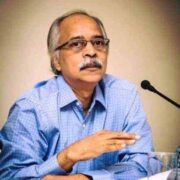

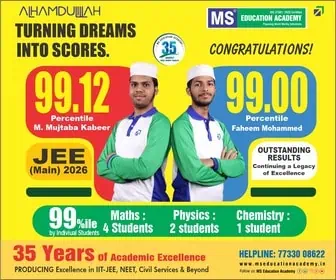
The mention of Dr Jayaraman, or simply Dr J, might not ring many bells to you, but for journalists of the Press Trust of India (PTI) and the innumerable media subscribers, it was an initial that meant a big science story. Within the Indian scientific community, too, he is a name to reckon with.
For over 40 years, between 1973 and 2015, Dr KS Jayaraman, or Dr J as he is known, made waves in science reporting. With passion and doggedness, he pursued the challenging task of generating stories that were catchy and readable from research work in the Indian institutes as well as globally, and brought them to the readers.
Dr Jayaraman, who celebrated his 90th birthday recently in Bengaluru, is regarded among the pioneers of science journalism in India, along with Dr Anil Agarwal, founder of the Centre for Science (Sustainable) Environment (CSE), which publishes the Down To Earth magazine. He laid the foundations for science journalism in the early 1970s.



A PhD holder from the University of Maryland, College Park, in the US, Dr Jayaraman briefly worked with the Bhabha Atomic Research Centre (BARC). He has not just broken stories that had a huge impact but also groomed a generation of science journalists through the PTI Science Service, which was his brainchild.
The PTI Science Service, started in the early 1980s, was an exclusive offering of special stories and coverage of scientific events across the major metros and centres of research activity in the country. It was a fortnightly bulletin containing stories and articles and was provided on subscription to media outlets, which used them in their special pages on science and technology or as news stories.
Dr J selected promising, young reporters in New Delhi (a separate desk was created), Mumbai, Bengaluru, Hyderabad and Lucknow, who would feed stories, articles and cover events regularly. It became popular by the mid-1980s and peaked with the economic reforms, opening up to global technology infusion, tie-ups, etc. and helped improve coverage of science, technology, agriculture and environment, among others.
A journalist with grit
The following are a few examples to illustrate the impact of Dr J’s reporting:
His series of investigative stories on the Genetic Control of Mosquitoes Unit, established by the World Health Organization (WHO) under the Indian Council of Medical Research, for suspected biological warfare studies linking yellow fever during the mid-1970s, is well known. Dr J worked wholeheartedly on a story for 15 months with PTI’s Chief Editor Chakravarthi Raghavan.
The story led to a storm in Parliament, and a joint parliamentary committee (JPC) was set up. The JPC vindicated PTI’s story. The then PM, Indira Gandhi, was forced to order the closure of the unit. The entire account is revealed in the PTI Book in a chapter named “Mosquitoes bite, journalists bite harder.”
Another example of his reporting excellence and zeal to chase news is the coverage of the Latur Earthquake of September 30, 1993. The early morning tremor had woken me out of my sleep in Hyderabad. I had rushed to the office to file a report after talking to the National Geophysical Research Institute (NGRI). Dr Jayaraman happened to be in Hyderabad along with a team of journalists from Delhi. His first question was, how far was Latur and we go and cover it. I said it’s about over 200 km away and easily accessible from Hyderabad by road.
The next day, early morning, we two were on our way. In a few hours, we approached the village and the devastating scenes. The entire day, we moved with great difficulty, guts and determination to capture the gravity of the human suffering that the 6.4 magnitude earthquake had wreaked on lakhs of poor people. There was no communication of any kind and only death, agony and relief work all around.
It was again the quick thinking and sharpness of Dr J that made the day for us. Dr J spotted an Indian Army outpost. He said, let’s go there. After reaching, he engaged an officer in conversation. Impressed upon him that we were news agency reporters, who were to report the reality and situation in Latur to the outside world. The security personnel had a satellite link for communication. We got quick access to the Satphone, called PTI Delhi and dictated the story.
Being a dedicated agency journalist throughout and having done monumental work before the internet era, Dr J remained low profile in public recall. However, his contributions will have an impact for many years.
Knack for storytelling
I distinctly recall the brilliant leads (first para) of his news stories, his immense curiosity, ability to find stories from any lab he visited or a scientific paper he read, a scientific conference he attended and finally the energy to keep writing. After his long innings in PTI ended around 2003, he took over as the Editor of NatureNews-India. Here, he presented scientific developments from India to global readers. He moved to Hyderabad for a few years before settling down in Bengaluru.
Even as he enters his 90s, Dr J has slowed down considerably and does not write, but continues to have the same curiosity and excitement about stories and popularising science.
These are some of the qualities I, as a journalist, learnt and strive to emulate from Dr J, with whom I closely worked for over a decade of my formative career in PTI (1983-93). Thereafter, for another decade, we were closely associated with the Indian Science Writers Association (ISWA), of which he is one of the founders, to popularise science reporting across the country.
During a three-year tenure, we could organise several activities under the aegis of the ISWA, of which Dr Jayaraman was the President. Some notable examples include the visit of science journalists to atomic energy establishments in Mumbai as part of a three-day workshop. We could interact with Dr Anil Kakodkar, Director of BARC, YS Prasad, Director of Nuclear Power Corporation of India Limited (NPCIL); Dr R Chidambaram, Chairman of Atomic Energy Commission (AEC), etc. In addition, a dozen of us could visit Trombay, BARC Laboratories, etc.
The ISWA also organised topical meetings with Dr RA Mashelkar, Director General (DG) of Council of Scientific and Industrial Research (CSIR), RS Paroda, DG of the Indian Council of Agricultural Research (ICAR); AA Gopalakrishna, Chairman of Atomic Energy Regulatory Board (AERB), etc., at the CSIR Centre, which often created good copy for the media.
The ISWA was able to send a “fact-finding” team to Bhopal in 1996 to assess and bring out a report on the Bhopal gas tragedy of 1984. Dr R Ramachandran of Frontline, Dr Jayaraman and a couple of others were members. Another important contribution during the period was the publication of the first-ever directory of ISWA members. The Indian Oil Corporation supported the venture.
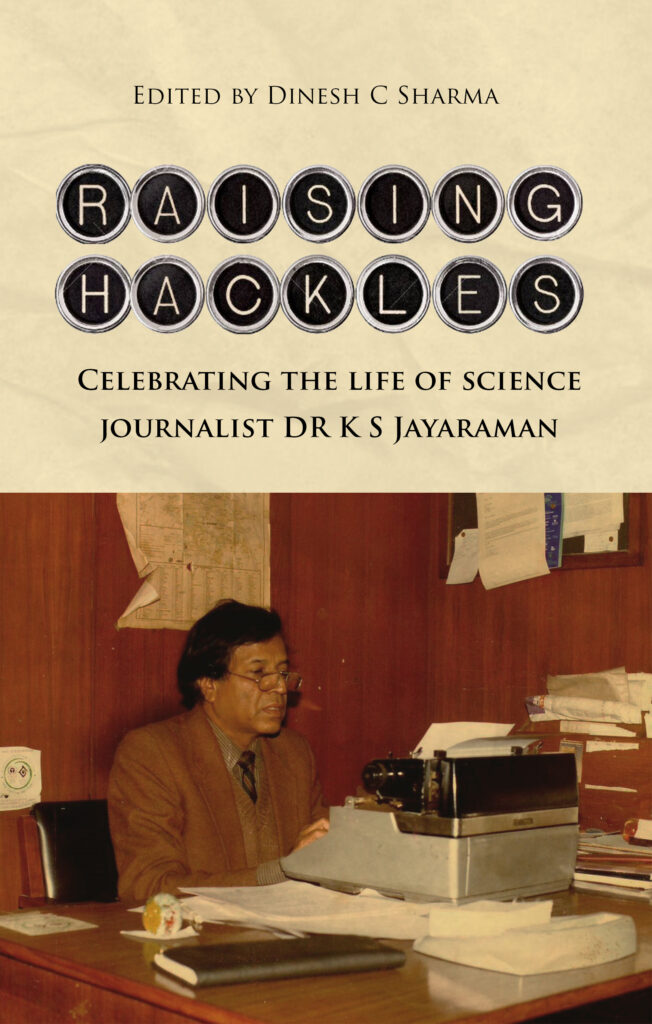
Dr Dinesh Chandra Sharma, one of the top science journalists and authors in India, has very nicely captured Dr J’s journey and contributions in a book titled “Raising Hackles-Celebrating the life of Dr K S Jayaraman,” with articles by some of the PTI science reporters like us, in 2020.
Among the large crop of science journalists that Dr Jayaraman trained or mentored are GS Mudur, with over 35 years of continuous science reporting with PTI and Telegraph now, Dr Dinesh Sharma, Dipesh Satpathy, Dr SM Johri, TN Ashok, G Sudhakar Nair, Dr Lalitha Vaidyanathan, KV Venkatasubramanian, Shubhra Priyadarshini, Editor of Nature News- India; TV Padma, Kalyan Ray, S Ahmed, TV Jayan, etc.
 |
|