


Iran’s Supreme Leader Ayatollah Mojtaba Khamenei has said foreign enemies will eventually be forced out of the Arabian Sea, as Tehran and Washington remain locked in a military and diplomatic confrontation.
In a series of posts on X on Monday, September 28, Khamenei said Iranian forces and those guarding the Strait of Hormuz had inflicted what he described as “painful blows” on their opponents.
“Today, because of the painful blows they have suffered at the hands of the valiant Iranian fighters & the guardians of the #StraitofHormuz, they dare not advance beyond the Arabian Sea,” he said.


Khamenei added that the presence of those forces in the region would not last, saying the Arabian Sea would soon be “rid” of them.
He also said Iran would not return to the period before the 1979 Islamic Revolution, which he described as an era of “backwardness, humiliation and dependency”.
Iran rejects claims over UK airbase bomb scare
Iran’s embassy in London has rejected speculation that Tehran was involved in a bomb scare near a UK military airbase used by the United States.

In a post on X on Monday, the embassy said it “categorically rejects and strongly condemns” what it described as speculation linking Iran to the incident near Royal Air Force (RAF) Fairford early Sunday.
The embassy criticised what it called “unfounded and malicious speculations” by some British individuals and media outlets seeking to connect Iran to the incident.
Five men, all British nationals in their mid-20s, have been arrested, while UK counter-terrorism police are leading the investigation.
US-Iran talks expected
Qatari mediators are expected to hold separate meetings with Iranian Foreign Minister Abbas Araghchi and US officials on Monday or Tuesday, September 29, as diplomatic efforts continue.
The discussions are expected to centre on an amended seven-day proposal put forward by Tehran on the sidelines of the United Nations General Assembly, according to an official briefed on the negotiations.
The proposed framework is linked to efforts to end the fighting and restore shipping through the Strait of Hormuz, while Washington is seeking concessions from Tehran over its nuclear programme and other issues.
Iran police chief orders preparations
Iranian Police Chief Ahmad Reza Radan has ordered officers to prepare for what he called the “worst-case scenario” amid the possibility of further US attacks, Iranian state media reported.
Speaking at a meeting with directors of the Faraja Political Ideological Organisation, Radan called for the country’s defence structures to be adjusted to the prevailing circumstances.
He said Iran needed to anticipate possible enemy actions and be ready to respond.
Iran has accused the US of committing war crimes during its military campaign. Foreign Minister Abbas Araghchi has alleged that attacks targeted vital infrastructure, including hospitals, schools, bridges and energy facilities.
Rial falls to record low
Iran’s currency has also come under renewed pressure, with the rial falling to a record low against the US dollar.
The dollar crossed 240,000 tomans on the free market, while the euro and British pound traded at about 273,000 and 318,000 tomans respectively, Iranian media reported.
Bonbast data put the dollar at roughly 2.45 million rials in Tehran’s unofficial market, compared with an official Central Bank rate of around 1.5 million rials.
Qatar-linked LNG ships pass through Hormuz
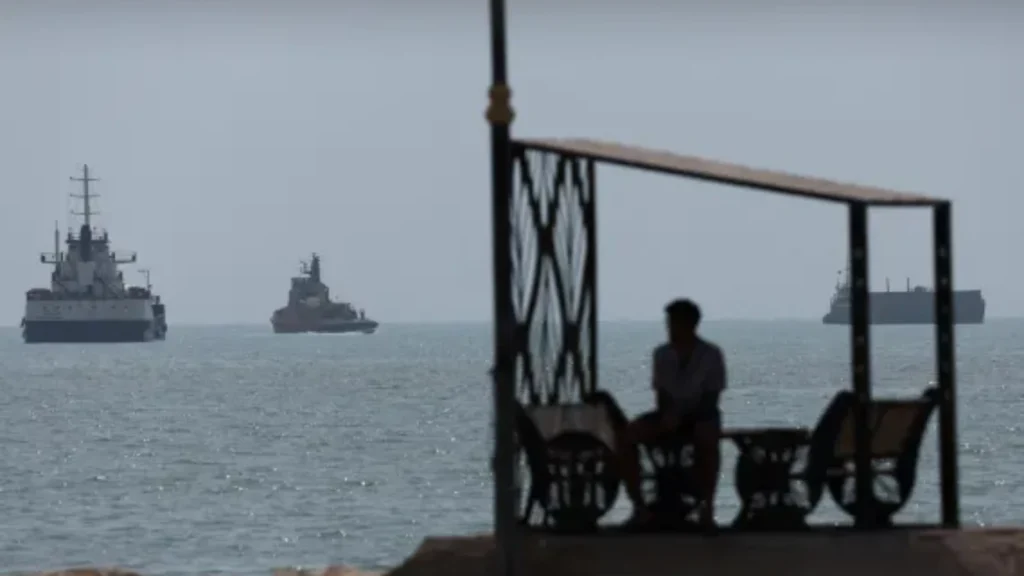
Several QatarEnergy-linked liquefied natural gas (LNG) vessels, including both loaded ships and those sailing in ballast, have passed through the Strait of Hormuz over the past week despite the conflict, Reuters reported.
The GasLog Skagen was the latest vessel to emerge from the waterway, appearing off Sri Lanka on Sunday, September 27, with a cargo from Ras Laffan, based on LSEG and Kpler data.
CENTCOM disputes Iran’s control claim
US Central Command (CENTCOM) has rejected an Iranian military claim that the Islamic Revolutionary Guard Corps has complete control over the Strait of Hormuz.
In a post on X, CENTCOM said Tehran’s assertion of “full control” over the strategic waterway was false.
The US command also claimed that more than one billion barrels of oil had travelled through the strait in recent months, citing the continued flow of shipments as evidence against Iran’s claim of control.

