


US President Donald Trump announced a 10-day ceasefire between Israel and Lebanon on Thursday, April 16, signalling a potential pause in hostilities amid wider efforts to de-escalate tensions linked to the Iran conflict.
In a post on Truth Social, Trump said both sides had agreed to begin a ceasefire at 5 pm EST (3:30 am IST) aimed at achieving peace between the two countries.
“I just had excellent conversations with the highly respected President Joseph Aoun of Lebanon, and Prime Minister Bibi Netanyahu of Israel. These two leaders have agreed that in order to achieve peace between their countries, they will formally begin a 10-day ceasefire,” he said.



Trump added that he would invite Israeli Prime Minister Benjamin Netanyahu and Lebanese President Joseph Aoun to the White House for talks.
“In addition to the statement just issued, I will be inviting the Prime Minister of Israel, Bibi Netanyahu, and the President of Lebanon, Joseph Aoun, to the White House for the first meaningful talks between Israel and Lebanon since 1983,” he said.
“Both sides want to see peace, and I believe that will happen, quickly.”


Lebanese officials had earlier indicated that President Joseph Aoun is not expected to engage in direct talks with Israeli Prime Minister Benjamin Netanyahu in the near future, despite Trump’s remarks.
Latest updates here
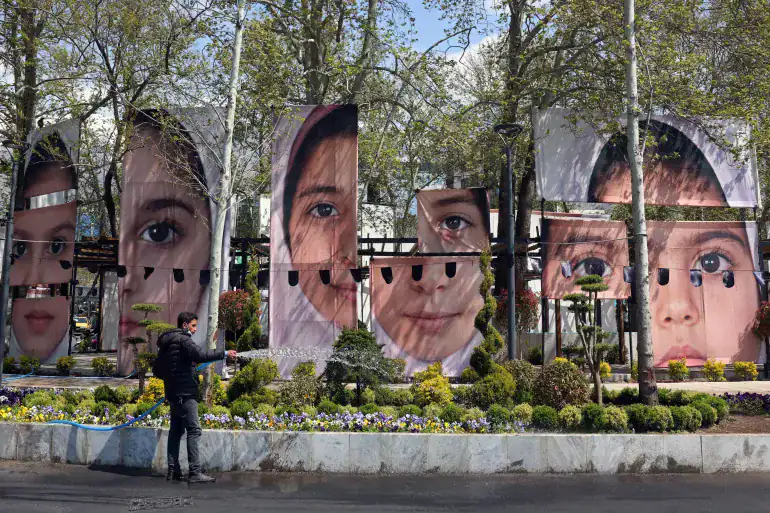
Tehran honours children killed in Minab attack with public displays

US details scale of Hormuz blockade operations
US Joint Chiefs Chairman Dan Caine said more than 10,000 sailors, marines and airmen are involved in enforcing the blockade, supported by ships, aircraft and helicopters, according to the Associated Press.
He said vessels approaching the restricted area are first warned to turn back or face boarding, with escalation options including warning shots and other measures if necessary.
Civilian toll rises in Lebanon conflict
Lebanon’s Health Ministry said that since the latest conflict between Israel and Hezbollah began on March 2, the death toll includes 260 women and 172 children.
It added that 7,185 people have been injured in the fighting, according to the Associated Press.
Iran slams US economic threats as ‘economic terrorism’
Iran’s foreign ministry spokesperson Esmail Baghaei criticised US Treasury Secretary Scott Bessent over what he described as economic threats, saying such measures harm “innocent people”.
Baghaei called the approach an “inhumane mindset”, describing US actions as “economic terrorism” and “state-sponsored extortion”.
His remarks were in response to Bessent’s warning of a “financial equivalent” of a bombing campaign, as Washington intensifies pressure on Tehran.
US says Iran’s supreme leader ‘wounded and alive’
US Defence Secretary Pete Hegseth said on Thursday that Iran’s supreme leader Mojtaba Khamenei is “believed to be wounded and alive”.
His remarks come amid multiple reports suggesting Khamenei sustained serious injuries during an airstrike at the start of the war that killed his father, former supreme leader Ali Khamenei.
Several media reports have claimed that Khamenei is still recovering from severe injuries, though there has been no official confirmation from Iranian authorities on the extent of his condition.
US says Iran weakened, warns of rapid military response
US Defence Secretary Pete Hegseth said Iran cannot replace its lost firepower, warning its military leadership that “we’re watching you”.
He said the balance of power was tilted, describing it as “not a fair fight”, and added that Iran was “digging out” remaining launchers and missiles without the ability to replenish them.
Hegseth said the US military was reloading with greater strength and remained “ready to go at the command of our president and at the push of a button.”
US ready to resume combat despite ceasefire, says Joint Chiefs chair
US Joint Chiefs Chairman Dan Caine said American forces are ready to resume combat “at literally a moment’s notice”, even as a ceasefire remains in place under President Donald Trump’s direction.
He said the US launched a naval blockade on April 13 targeting Iran’s ports and coastline, rather than the Strait of Hormuz.
Caine added that the blockade applies to all vessels, regardless of nationality, travelling to or from Iranian ports.
Syria says former US military sites taken over
Syria said it has completed the takeover of military sites previously used by US forces, describing the move as a sign of the integration of Kurdish-led Syrian Democratic Forces (SDF) fighters into state structures.
The development follows a January ceasefire deal between Damascus and Kurdish forces, which outlined a phased merger of SDF units into the national system after years of US-backed operations against Islamic State.
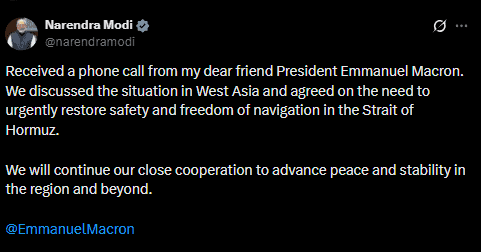
Modi, Macron discuss Hormuz security in phone call
India’s Prime Minister Narendra Modi said he received a phone call from French President Emmanuel Macron, during which they discussed the situation in West Asia and the need to restore maritime security.
“We discussed the situation in West Asia and agreed on the need to urgently restore safety and freedom of navigation in the Strait of Hormuz,” Modi said in a statement.
He added that both leaders would continue close cooperation to advance peace and stability in the region and beyond.
US blockade deters vessels in Strait of Hormuz
US Central Command said American forces have turned back 14 vessels in the 72 hours since the blockade of the Strait of Hormuz came into force, underscoring the impact of Washington’s maritime pressure campaign.
The US has maintained that the blockade is limited in scope, targeting only ships entering or leaving Iranian ports.
Earlier, a senior Pentagon official said several vessels had already turned back rather than challenge the blockade.
General Dan Caine said enforcement would extend across both Iran’s territorial waters and international waters, though no ships had yet been boarded.
Lebanon’s President speaks to Trump on ceasefire efforts
Lebanese President Joseph Aoun held a phone call with US President Donald Trump on Thursday, during which ceasefire efforts were discussed, according to an official statement.

Israel warns Iran over nuclear proposal, vows ‘painful’ strikes
Israel’s defence minister Israel Katz warned Iran against rejecting a US proposal centred on abandoning nuclear armament, vowing “even more painful” strikes on new targets if Tehran refused.
He said Iran faced a “historic crossroads” between compliance and escalation.

Iran links Lebanon ceasefire to wider negotiations
Iran’s parliament speaker Mohammad Bagher Ghalibaf said a ceasefire in Lebanon was as important as one in Iran during talks with Lebanese Speaker Nabih Berri, AFP reported.
He said Tehran was working to secure a permanent ceasefire across all conflict zones as part of ongoing negotiations.
US warns of renewed strikes if Iran rejects deal
US Defence Secretary Pete Hegseth said American forces in West Asia were ready to resume combat operations if Iran did not agree to a peace deal.
He warned that failure to comply could result in strikes targeting infrastructure and energy facilities.
Israeli strike kills one on Beirut–Damascus road
An Israeli strike targeting a vehicle on the road between Beirut and Damascus killed one person in the Dahr al-Baidar area, according to Lebanon’s National News Agency.
Pakistan steps up mediation with Iran
Pakistan’s army chief Asim Munir met Iran’s parliament speaker in Tehran as part of efforts to push for a ceasefire involving the United States and Israel.
Shehbaz Sharif in Doha for fresh ceasefire push
Pakistan Prime Minister Shehbaz Sharif arrived in Doha after visiting Saudi Arabia, seeking to advance a second round of talks between Washington and Tehran, AFP reported.
He is expected to meet Emir Sheikh Tamim bin Hamad Al Thani to discuss ongoing efforts for regional and global peace, with a focus on securing a broader ceasefire framework.

