
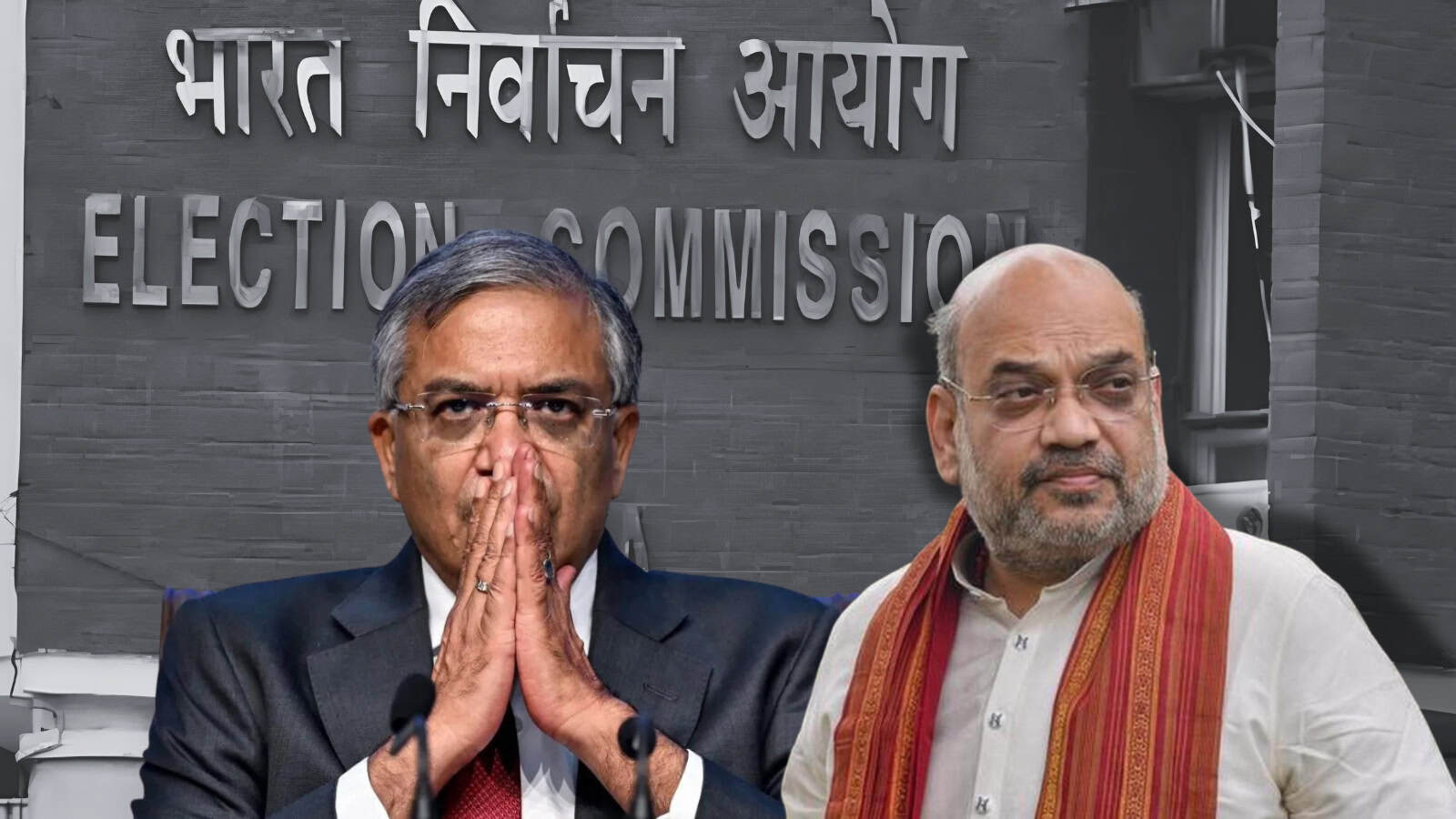
New Delhi: The Election Commission’s (EC) software used in the Special Intensive Revision (SIR) of electoral rolls had no provision to flag any voter as a foreign national, according to an investigation by The Reporters’ Collective, with the finding raising questions over claims that “infiltrators” were among the 13.39 crore names struck off the rolls.
Earlier, Union Home Minister Amit Shah had accused Leader of Opposition Rahul Gandhi of trying to shield infiltrators by targeting the poll body, even as protests over the exercise continue across India.
“I want to tell Rahul Gandhi ji that the nation is well aware of your plan to save ghuspaithiyas (infiltrators) and now the people of Bharat are not going to fall for your ploy,” Shah said in an interview on Tuesday, October 13. He suggested that infiltrators were among the voters deleted during the exercise.


However, The Reporters’ Collective said its examination of the EC’s software, together with replies to its Right to Information (RTI) applications, showed the commission had no mechanism to tag any deleted voter as a foreigner. More than 100 Electoral Registration Officers (ERO) in Bihar replied to its RTI queries and confirmed that no such category had been recorded, it said.
No record in Bihar
Bihar was the first state to undergo the SIR, which began there in June 2025. At the time, the EC had said that weeding out infiltrators was one of the main aims of the exercise.
After enumeration ended in July 2025, the commission claimed that a large number of foreign nationals had been detected during house-to-house verification. But the official deletion figures released in September listed only absent, shifted and dead voters.

The EC repeated the stated purpose of the exercise when the SIR was challenged in the Supreme Court. Upholding the revision, the top court directed the commission to refer, within four weeks, cases of people removed on the ground of not being citizens to the competent authority under the Citizenship Act, 1955.
That authority would be the Union Ministry of Home Affairs (MHA).
It is not publicly known whether the EC has placed any such list before the court, the report said.
After the deadline lapsed, The Reporters’ Collective filed an RTI application asking whether the commission had complied with the order and shared such cases with the MHA. It specifically sought details of suspected foreign nationals in Bihar and West Bengal. By then, the SIR had been completed in 13 states and Union Territories.
The EC did not answer the questions directly. It forwarded them only to Bihar, saying election authorities in Patna were best placed to respond. Replies from Assembly constituencies in the state gave numbers of voters removed as absent, shifted, dead and under other heads, but made no mention of any non-citizen.
Phase two dropped the category
By the second phase of the SIR, which covered 12 states, the commission’s internal rules no longer required Booth Level Officers (BLO) to identify or report non-citizens. Voters who did not return their enumeration forms were to be deleted. BLOs were given four grounds for doing so – absent, shifted, duplicate or dead.
In this phase, the EC also used an algorithm to flag “unmapped” voters, meaning those who could not trace their names or family links to the 2002–2004 electoral rolls. Such voters were called for hearings and removed if they could not produce the documents the commission had specified. The report described the algorithm as the ECI’s tool for identifying purported infiltrators.
The algorithm was rolled out months before the West Bengal Assembly polls. During the campaign, Shah repeatedly vowed to “detect, delete and deport” infiltrators if the Bharatiya Janata Party (BJP) came to power in the state.
Bengal hearings, UP forms
The Reporters’ Collective said its reporters attended SIR hearings in West Bengal, the state where the largest number of voters have been removed through such hearings so far. They also examined ERONET, the software election officers use to delete names, and found no option to mark a voter as a non-Indian.
In Uttar Pradesh, the investigation found that Form 7, the statutory form required to delete a voter, was auto-generated after hearings and already carried the election officer’s signature. As a result, around 86,000 voters deleted during hearings in the state have no reason recorded against their names, the report said.
The deletions have had real consequences in West Bengal. After the BJP won the state, party leaders there cut welfare benefits for people who had been removed during the SIR. Days earlier, Chief Minister Suvendu Adhikari had said that “no deceased person, illegal infiltrator, or non-Indian individual will be allowed to avail benefits meant for citizens of the state.”
Opposition leaders have continued to press the commission to disclose details of the alleged infiltrators, the identification of whom was cited as one of the reasons for launching the SIR.
 |

