


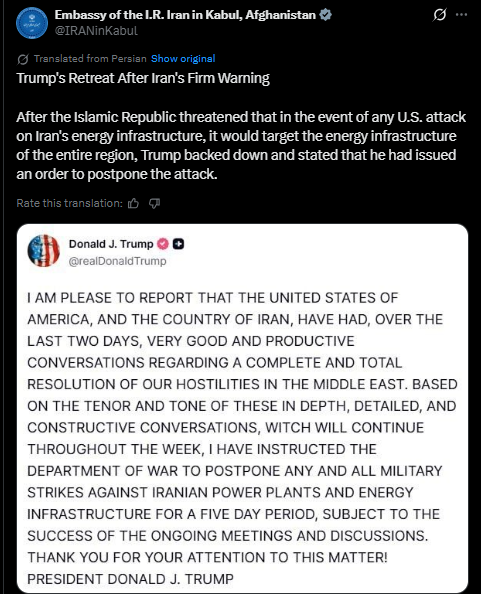
US President Donald J Trump has ordered a five-day halt to planned military strikes on Iran’s power plants and energy infrastructure following what he described as “very good and productive” talks with Tehran, signalling a potential diplomatic opening in the ongoing conflict.
In a statement on Monday, March 23, Trump said the United States and Iran had held “in-depth, detailed and constructive conversations” over the past two days aimed at achieving a “complete and total resolution” of hostilities in the Middle East.
He added that he had instructed the US military to postpone “any and all” strikes on Iranian power plants and energy infrastructure for five days, with further decisions dependent on the outcome of ongoing discussions expected to continue throughout the week.



The move marks a shift from Washington’s earlier hardline stance, after Trump issued a 48-hour ultimatum warning Iran to reopen the Strait of Hormuz — a vital global oil transit route — or face direct attacks on its energy facilities.
Iran had earlier warned it would retaliate by targeting Israeli power plants and US-linked infrastructure across the Gulf if its own energy network was attacked, raising fears of a broader regional escalation.
The Strait of Hormuz remains a central flashpoint in the conflict, with disruptions threatening global energy supplies and shipping routes, as tensions between the US, Israel and Iran continue to reverberate across the region.

Iran claims US ‘backed down’ after warning
Iran’s embassy in Kabul claimed that Trump stepped back from planned military action after Tehran issued a strong warning over potential retaliation.
Describing the development as a “retreat”, the embassy said the delay in strikes followed Iran’s warning, suggesting the US decision came in response to heightened threats from Tehran.
Iran state TV: Trump ‘backed down’ after warning
Iranian state television echoed the claim, stating in an on-screen graphic: “US president backs down following Iran’s firm warning,” according to Associated Press.
Iran says no talks with US, questions intent
Iran’s semi-official Mehr News Agency cited the Foreign Ministry as saying there is currently no dialogue between Tehran and the United States.
The ministry said Trump’s remarks are aimed at lowering energy prices and buying time for military plans, adding that while regional “initiatives” exist to reduce tensions, concerns should be directed at Washington, which it described as “the party that started this war”.
Oil prices drop as escalation fears ease
Oil prices fell sharply after Trump ordered a delay in military action against Iran’s energy infrastructure, easing fears of an immediate escalation in the region.
Brent crude dropped to around USD 96 a barrel, with futures falling by about USD 17, or roughly 15 percent. US West Texas Intermediate declined by around USD 13, or 13.5 percent, to about USD 85.28.
The decline came as markets reacted to the reduced risk of supply disruption, particularly around the Strait of Hormuz, a key route for global oil shipments.
UAE restarts key gas plant amid disruptions
Amid ongoing tensions affecting regional energy flows, the United Arab Emirates has restarted a key gas plant while keeping most liquefied natural gas production shut, according to Bloomberg News.
Israel launches fresh strikes in Tehran
Meanwhile, Israel’s military said it has launched another wave of air strikes targeting infrastructure linked to what it described as Iran’s “terror regime” across Tehran.
The strikes mark a fresh escalation despite the US pause, underscoring the fragile nature of the situation and the risk of further regional spillover.
Hormuz tensions to keep markets unstable
Iran’s Tasnim News Agency, citing an official, said the Strait of Hormuz will not return to pre-war conditions, warning that energy markets are likely to remain volatile.
The report said there are no ongoing negotiations between Iran and the United States. It added that Trump stepped back from plans to target key Iranian infrastructure amid pressure from financial markets.
India taps 41 nations for energy amid Hormuz tensions
India is working to ensure uninterrupted supplies of oil, gas and fertilisers despite disruptions in the Strait of Hormuz, Prime Minister Narendra Modi said.
Addressing the Lok Sabha, Modi said India has diversified its energy imports over the past decade and is currently sourcing supplies from 41 countries to reduce vulnerability.
India ‘closely monitoring’ situation
India said it is closely monitoring developments following Trump’s decision to delay planned strikes.
Responding to a query, Ministry of External Affairs spokesperson Randhir Jaiswal said New Delhi is keeping a watch on the situation.
“Yes, we are closely following these developments as we do,” Jaiswal said, without elaborating further.
UAE intercepts missiles and drones
The United Arab Emirates said its air defence systems intercepted seven ballistic missiles and 16 unmanned aerial vehicles launched from Iran on March 23, as hostilities continued to escalate.
Since the onset of what it termed Iranian aggression, the UAE said its defences have engaged 352 ballistic missiles, 15 cruise missiles and 1,789 UAVs.
The attacks have killed two armed forces personnel and six foreign nationals, while 161 people of multiple nationalities have been injured. Authorities said the military remains fully prepared to counter threats and safeguard national security.
Iran denies charging ships in Hormuz
The Iranian Embassy in New Delhi has dismissed reports alleging that Tehran is charging vessels millions of dollars to pass through the Strait of Hormuz, calling the claims “unfounded”.
In a statement, the embassy said assertions that Iran received USD 2 million from ships transiting the strategic waterway were baseless. It added that such remarks reflect only “personal views” and do not represent the official position of the Iranian government.
Indian LPG carriers move through Hormuz
Two Indian-flagged LPG carriers have begun their journey from the Persian Gulf and are expected to cross the Strait of Hormuz en route to Indian ports.
The vessels — Pine Gas and Jag Vasant — were sailing close to Iran’s Larak and Qeshm islands, suggesting an effort to signal identity to Iranian authorities before transiting the key route.
Of the 22 Indian-flagged vessels on the western side of the Strait, six are LPG carriers. Two have now departed towards India.
Oman works to ensure safe passage in Hormuz
Oman, which has mediated nuclear talks between the United States and Iran, said it is working to secure safe passage through the Strait of Hormuz.
Foreign Minister Badr Albusaidi said in a statement on X that Oman is “working intensively to put in place safe passage arrangements” for the vital shipping route.“Whatever your view of Iran, this war is not of their making,” he added.
South Korea urges Iran to ensure vessel safety
South Korea’s Foreign Minister Cho Hyun has urged Iran to ensure the safety of vessels transiting the Strait of Hormuz, amid rising concerns over the economic fallout of the escalating conflict.
During a phone call with his Iranian counterpart, Cho expressed deep concern over the impact of the crisis on global energy supplies and the wider economy, and called for safe navigation through the strategic waterway.

