


Sunday, June 21, marks the 114th day of the US-Israel war on Iran as talks between Iran and the United States formally begin in Switzerland with the mediation of Qatar and Pakistan.
Speaking at the Lake Lucerne Summit in Burgenstock, US Vice President JD Vance described the negotiations as a “historic” meeting and said Washington hoped to begin a new chapter in its relationship with the Iranian people.
Vance said the region could either “turn over a new leaf” and pursue a different future or return to the “old way” of conflict and instability. He added that Washington hoped to begin a new chapter in its relationship with the Iranian people and address longstanding disputes through diplomacy.


This comes after Qatar’s Ministry of Foreign Affairs announced the start of the Lake Lucerne Summit, describing it as the first meeting involving the United States, Iran and the two mediating countries. The ministry said it hoped the negotiations would lead to a comprehensive agreement covering all aspects of the memorandum of understanding signed by the two sides.
Qatari Foreign Ministry spokesperson Majid Al-Ansari said technical and engineering working groups had been formed to negotiate the terms of a final agreement between Washington and Tehran. Additional follow-up groups have also been established to oversee the implementation of the memorandum of understanding and support efforts towards a permanent settlement.
US Vice President JD Vance, Pakistan Prime Minister Shehbaz Sharif and Pakistan Army Chief Field Marshal Asim Munir arrived in Switzerland on Sunday to participate in the negotiations. The Iranian delegation is led by Parliament Speaker Mohammad Bagher Ghalibaf and includes Foreign Minister Abbas Araghchi.

According to Axios, Qatari Prime Minister Sheikh Mohammed bin Abdulrahman Al Thani arrived in Switzerland on Friday, June 19, ahead of the talks. The negotiations were originally scheduled to start that day but were postponed amid uncertainty over the security situation in Lebanon.
The negotiations follow an agreement signed by Washington and Tehran on June 17 aimed at ending the conflict and establishing a framework for broader regional stability.
Trump warns Iran over proxies in Lebanon
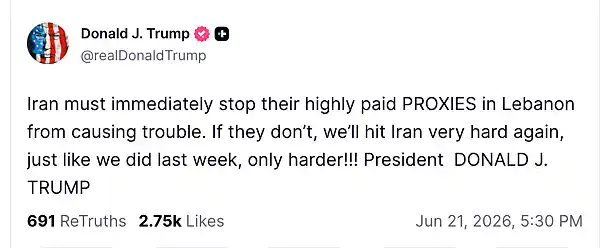
US President Donald Trump warned Iran against supporting allied groups in Lebanon, saying Tehran would face consequences if attacks continue.
In a post on social media, Trump said Iran must immediately stop its “proxies” in Lebanon from causing trouble. He warned that the United States would respond forcefully if the situation escalates further.
Trump warns Iran over Hormuz and Lebanon
US President Donald Trump said the memorandum of understanding signed between Washington and Tehran was only an extension of the ceasefire and should not be viewed as a final agreement.
In an interview with Fox News, Trump warned that Iran must make serious commitments during the negotiations and reiterated that multiple options remained available to the United States if diplomacy failed.
Trump also called on Tehran to rein in allied groups in Lebanon, warning of consequences if attacks continued. He said he had raised concerns directly with Iranian officials about the Strait of Hormuz and cautioned against any move to disrupt shipping through the strategic waterway.

The US president said Washington could consider measures affecting maritime transit through the strait if negotiations collapse, while stressing that securing a lasting agreement with Iran remained the administration’s primary objective.
Trump also suggested that regional security arrangements could undergo broader changes as diplomatic efforts continue, and criticised ongoing destruction linked to the conflict in Lebanon.
Leaders hail start of negotiations
Qatari Prime Minister Sheikh Mohammed bin Abdulrahman Al Thani said the launch of the talks marked an important moment for regional and global security.
He praised the efforts of US Vice President JD Vance, Pakistan Prime Minister Shehbaz Sharif and Iranian Foreign Minister Abbas Araghchi in bringing the negotiations to this stage, describing the meeting as the beginning of a broader process aimed at achieving long-term goals.
Sheikh Mohammed said the discussions represented only the first step towards building a better future for the region.
Sharif said intensive diplomatic efforts had made the meeting between Washington and Tehran possible and expressed hope that the negotiations could produce a framework for peace.
He described the opening of the talks in Burgenstock as a significant day for international diplomacy as direct discussions between US and Iranian officials prepared to begin.

Vance calls for new chapter with Iran
US Vice President JD Vance said President Donald Trump had instructed officials to pursue a new chapter in relations with the Iranian people as part of a broader effort to reshape the Middle East through diplomacy.
Vance described the Switzerland talks as the start of a technical negotiating process that would allow the parties to engage directly for the first time, even if major differences remain unresolved.
He said the Trump administration was committed to achieving a comprehensive regional ceasefire and pointed to recent progress in Lebanon, crediting mediation efforts by Qatar and Pakistan.
Vance added that Washington was seeking lasting regional stability and a future in which countries across the Middle East could work together to promote peace and prosperity.
Sharif hopeful of breakthrough
Sharif praised Trump’s role in bringing the parties together and expressed hope that the negotiations would produce constructive results.
He said the discussions could help advance efforts towards a lasting agreement in the region.
Israeli President backs candid US dialogue
Israeli President Isaac Herzog said discussions with the United States should remain private and be conducted in an open and frank manner, reflecting the longstanding relationship between the two allies.
In an interview with Fox News, Herzog said Israel and the United States continue to work closely to prevent Iran from acquiring nuclear weapons capabilities.
He also acknowledged that differences of opinion can arise between the allies, adding that Israel believes it is appropriate to raise concerns when necessary.
Iran says Lebanon ceasefire key to final US agreement talks
Iranian Foreign Ministry spokesperson Esmaeil Baghaei said progress towards a final agreement depends on the implementation of key commitments contained in the memorandum of understanding signed to end the conflict, particularly provisions requiring an end to hostilities across all fronts, including Lebanon.
In a post on X, Baghaei said Sunday’s discussions are focused on reviewing the implementation of those commitments and assessing measures related to Iranian oil exports and the release of Tehran’s frozen assets. He added that negotiations on a final agreement cannot move forward until the relevant provisions of the deal have been carried out.
Baghaei also said Washington’s failure to secure a ceasefire in Lebanon would be a key issue during discussions with US officials in Burgenstock.
Israel vows to maintain security zone in Lebanon
Israeli Defence Minister Israel Katz said on Sunday that Israeli troops would remain deployed in what Israel describes as a security zone in southern Lebanon.
Katz said soldiers had the authority to act against any perceived threats, signalling that Israeli forces would continue operations in the area despite ongoing diplomatic efforts to secure a ceasefire.
Photos: Delegations in Switzerland


Lebanese army clears unexploded bombs
The Lebanese army said its specialised engineering units are continuing operations to remove unexploded bombs left behind by Israeli strikes in several towns across the country.
According to the army, the ordnance includes aerial bombs weighing up to 1,000 and 2,000 pounds. The devices are being transported to secure locations for disposal to reduce risks to civilians living in affected areas.
The military also urged residents to follow the instructions of deployed army units, warning that ongoing violations and the threat of further strikes continue to pose safety risks.
IAEA chief backs diplomatic efforts
International Atomic Energy Agency (IAEA) Director General Rafael Mariano Grossi said he met Swiss Foreign Minister Ignazio Cassis in Burgenstock to discuss recent developments involving Iran, the course of the negotiations and the role of the UN nuclear watchdog.
In a post on X, Grossi stressed the importance of diplomacy as talks continue in Switzerland, saying all efforts should be made to ensure a diplomatic solution is given the best chance of success.
Pezeshkian defends Iran’s enrichment programme
Iranian President Masoud Pezeshkian said Tehran remains willing to provide assurances that it is not seeking to develop a nuclear weapon, while reaffirming that Iran will not give up its uranium enrichment programme.
Speaking ahead of talks with US negotiators in Switzerland, Pezeshkian said Iran could formally state that it has no intention of building an atomic bomb. However, he insisted that uranium enrichment remains a sovereign right that Tehran is unwilling to surrender.
Iran says talks are not its primary option
Hojjatoleslam Abdollah Haji Sadeghi, the chief representative of Supreme Leader Mojtaba Khamenei to the Islamic Revolutionary Guard Corps (IRGC), said negotiations with the United States were not Tehran’s preferred course of action and stressed that Iran was not entering the talks from a position of weakness.
In remarks published on Telegram, Sadeghi said Iran would approach the negotiations with “power and caution” while remaining prepared for other options. He ad ded that Tehran was not concerned about the possibility of the talks failing.
Sadeghi maintained that Iran had not entered the negotiations out of desperation and said the country’s position remained rooted in what he described as resistance and self-reliance.
Iran, Qatar discuss implementation of agreement
Iranian Parliament Speaker Mohammad Bagher Ghalibaf met Qatari Prime Minister and Foreign Minister Sheikh Mohammed bin Abdulrahman Al Thani in Switzerland to discuss the implementation of provisions outlined in the memorandum of understanding between Tehran and Washington, according to Iranian state media.
Iran outlines priorities for talks
Iran’s foreign ministry spokesperson Esmaeil Baghaei said the United States’ failure to secure a ceasefire in Lebanon would be a key issue during talks with American officials in Burgenstock, Switzerland.
Baghaei said the meeting was intended to follow up on the implementation of a memorandum of understanding between Tehran and Washington. He added that a joint session involving Iran, the United States, Qatar and Pakistan was scheduled later in the day.
Other topics expected to be discussed include exemptions related to Iranian oil exports and the release of Tehran’s frozen assets, according to Baghaei.
Iran maintains Strait of Hormuz closure
Iran’s Fars News Agency, citing military sources, reported on Sunday that the Strait of Hormuz remains closed. The report said the IRGC Navy will not issue permits for vessels to pass through the waterway until further notice.
Israeli military casualties mount in Lebanon
Six Israeli soldiers have been killed in Hezbollah attacks in southern Lebanon since Thursday, according to Israeli Army Radio.
Israel’s public broadcaster reported that the fatalities included a senior officer, while more than 20 soldiers have been wounded during the past three days.
Haaretz reported that 36 Israeli soldiers have been killed in Lebanon since the current round of fighting began on March 2, underscoring the continuing human toll of the conflict along the Israel-Lebanon border.
Iran demands full implementation of deal
Mohammad Mokhbar, an adviser and assistant to Iran’s Supreme Leader, said Tehran would not accept an agreement that exists only on paper and insisted that Washington must fully implement its commitments.
In a post on X, Mokhbar argued that the United States responds primarily to economic pressure, warning that energy flows from the Middle East could be disrupted if the agreement is not enforced in practice.
He said Iran’s negotiating team would seek the full implementation of commitments and the protection of the country’s rights during the talks.
Mokhbar also referenced those killed during the conflict, saying Tehran would not overlook their sacrifice as negotiations move forward.
Lebanon ceasefire in focus
An emergency discussion on Lebanon has been added to the negotiations in Switzerland and is expected to be taken up before other issues, CNN reported, citing a diplomat familiar with the talks.
Before departing for Switzerland, Vance said one of the key goals of the diplomatic effort was to make progress towards a ceasefire in Lebanon, where tensions have escalated following renewed Israeli missile attacks.
Iran has also signalled that developments in Lebanon will be a major focus of the negotiations. According to CNN, an Iranian official described ending the fighting in Lebanon as the delegation’s top priority in the talks.

