
Union Home Minister had some advice to trainee Indian Police Service (IPS) officers at their passing out parade in Hyderabad on October 17, which, prima facie, is laudable. Once in service, he told them to show “humility, restraint and commitment to the Constitution,” according to The Hindu reported. Recognition must be earned by their performance and by staying away from publicity. Their “authority was a responsibility rather than a symbol of their status,” he said.
That, in short, is what good policing is. Right from the time KF Rustomjee talked about police reforms, the country has been waiting for such policing, both in concept and in performance. As of now, it is sorely missing.
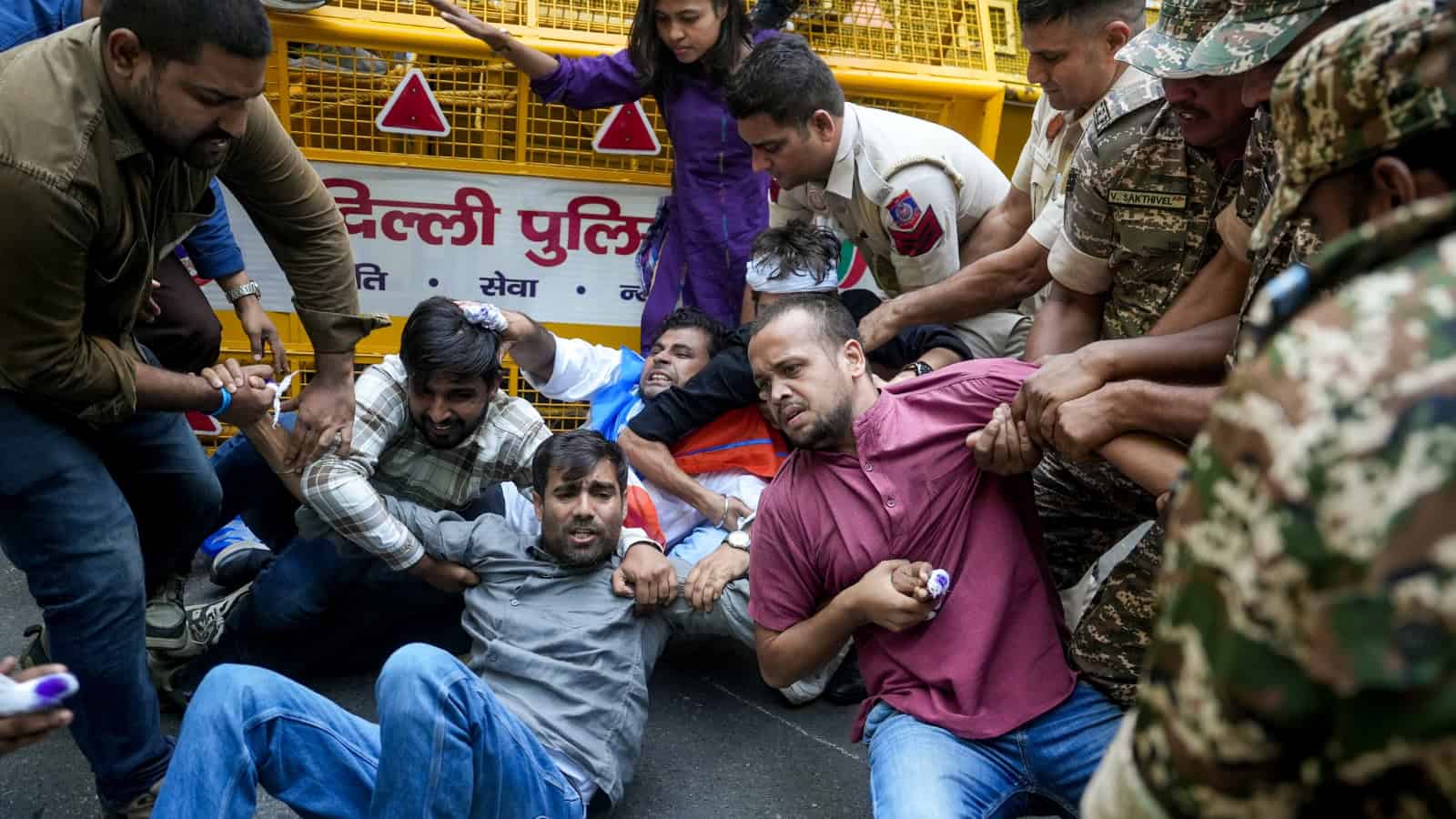
The recent work by the personnel in khaki in Delhi while dealing with the Gen Z protests called by the Cockroach Janta Party (CJP), the All India Students Association (AISA) and other activists, showed that the policing was miles away from that.


The question arises whether Shah sent that message to the trainees via Home Secretary Govind Mohan as a reaction to the adverse notice the management of the Gen Z protests received from civil society and sections of the media, both print, electronic and television. Or, whether it was merely a “good speak” in a routine manner.
One hopes that it is the former because a corrective is sorely required. The country would happily accept the reform.
Brutality right from the start
Brutality was witnessed right from the start of the Gen Z protests at Jantar Mantar in July seeking reforms in the testing system that graded students seeking higher education to the more recent “Lehra Do Tiranga” rally at Connaught Place in Delhi’s Lutyens. There have been allegations, backed by video footage, of the way the protestors were hauled away, the pellet gun shots and the absence of name tags on the uniforms the force’s personnel wore.

It was not limited to managing the site of the protest to secure dominance but even how they were carted away in buses to destinations not known till some of them were released, some in a wilderness because even their phones had been snatched. Everything that was bad in policing, reminiscent of a colonial force subjugating the subjects in the pre-Independence era.
That was hard to stomach.
It is difficult, therefore, to accept that Shah’s message was a clarion call to the police to perform their duties in a professional manner, that he is looking for foundational changes in the way the citizen is treated at all times and especially when in a crowd. History persuades us that the political establishment only likes a subservient police force. He has to walk the talk.
Other countries have shown how protestors are dealt with without violence unless the circumstances are extremely provocative.
Social media, a source of documentation
Social media has provided the dominant narrative, which brought to light what most of the mainline and legacy media sidestepped. Every person with a smartphone turned into a journalist or did what a good journalist should do and be allowed to do by the media outlet.
The mainline or legacy media did not provide a peep into the happenings as the social media did. The few exceptions were the Indian Express, The Hindu and the Deccan Herald. News TV was a sorry spectacle, true to Ravish Kumar’s description of what godi media is.
The grievance is so strong and documented in these graphic videos that the protestors and their leaders are unlikely to let the police misconduct go unchallenged in the courts. There admittedly are several lawyers offering pro bono legal services; many had even gone to detention centres to wait outside locked gates to get the detainees out or tried to intervene in real time at the protest sites.
This ECI is not Election Commission of India
There is a method to the work being done by the backroom boys of the Gen Z movement. A voluntary group, going by consistent and repeated posts on Instagram, is busy collecting evidence and calls the project Evidence Collection Initiative, which abbreviates ironically to ECI.
They have a site where videos of police misconduct can be submitted, and after approval, the backroom boys take over the task, which include listing the name and identity of the person who submitted, forensically reading the date, time and location of the upload, the URL and the number of likes the posts on social media got, among others.
This database is intended, the posts say, to help researchers, lawyers and journalists who may use it. It is also described as warehousing history because the uploads of reels by individuals during the protests has been overwhelming and none of the three categories – researchers, lawyers and journalists – would find it hard to scout them out by mere scrolling.
The algorithms and the sheer number of the uploads can make the process for independent researchers numb.
 |