

Hyderabad: On June 27, a group of men walked into Bharat Chandra School in Armoor, in Telangana’s Nizamabad district and confronted the principal in front of the police. The principal, 37-year-old Amer Khan, was slapped. The man who slapped him was Mandula Balu, the Bharatiya Janata Party’s (BJP) town president in Armoor. The alleged offence was that the school had allowed Urdu to be taught.
Within 24 hours of his remand, Balu was granted conditional bail. Khan, the man who was hit, is now before the Telangana High Court seeking anticipatory bail in a case filed against him.
That inversion, where the assaulted becomes the accused, is the thread running through Telangana’s second quarter.


The numbers and what they hide
Siasat.com documented seven cases of religious hate crime against minorities in Telangana in the second quarter – six against Muslims and one against Dalits. No hate crime against the Christian community was documented.
On paper, this is a sharp fall. The first quarter had 27 cases.
But a quarterly count does not give the full picture. It records incidents, not consequences. It cannot register how quickly bail arrives, how reliably a station house officer (SHO) declines a counter-complaint or how efficiently a viral video is taken off the internet.
Read alongside what followed each of these incidents, the drop is less like relief and more like a pause.
When a workplace row became ‘corporate jihad’
The quarter’s most politically consequential story did not originate in Telangana at all.
In Nashik, a Hindu woman from the Scheduled Caste/Scheduled Tribe (SC/ST) community levelled allegations against eight Muslim colleagues at Tata Consultancy Services, including two women, of sexual harassment, coercion and attempts at religious conversion. The case took the country by storm.
In Hyderabad, the Vishva Hindu Parishad (VHP) and the Bajrang Dal called for a protest against what they termed “corporate jihad,” a phrase coined by Hindutva forces to allege that Muslim men and women are now targeting Hindu women in workplaces such as multinational companies.
The significance of the term lies in where it points. It moves the suspicion into glass buildings and HR departments, into a sector that has absorbed a large share of this city’s Muslim graduates.
Beef, cattle and a truck full of plywood
In Jagtial, a Muslim father and son were subjected to humiliation over an allegation of selling beef.
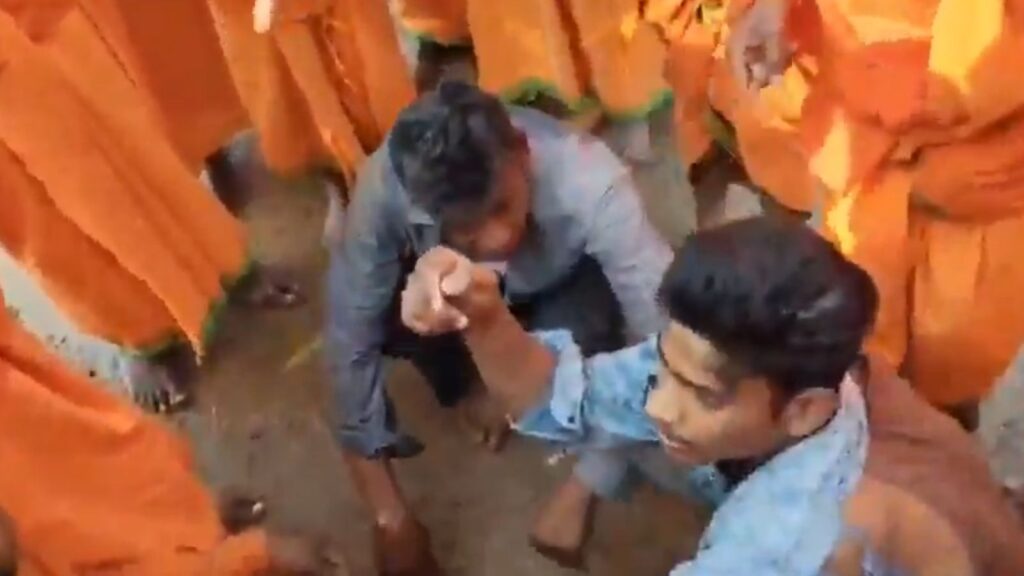
Mohammed Qureshi and his 16-year-old son, Mohammed Anas, were surrounded by a mob of saffron-clad men. Their clothes were torn and their heads were shaved. “Take off his clothes,” the crowd said.
Qureshi was beaten repeatedly and kicked to the ground. Four people were arrested. All four were granted bail within 15 days.
Two further incidents in the quarter involved self-proclaimed gau rakshaks, or cow vigilantes, who attacked vehicles alleging that cattle were being transported for slaughter.
The first was on May 11 in Hyderabad, when a truck carrying oxen was intercepted at Kottapet Road near the Chaitanyapuri Metro station. The second on May 18, when between 20 and 30 men attacked a container near Tappachabutra, suspecting it was carrying cattle.
It was not. The vehicle had come from Maharashtra and was loaded with plywood, and videos circulating on social media showed this clearly. No animals were found.
The driver, Sheikh Rasool, was attacked anyway. The container was damaged. A case was filed. So far, little action has been taken.
There is a pattern here which has nothing to do with cattle. The suspicion is the point; the cargo is incidental.
Shopping while pregnant
In early May, two pregnant Muslim women said they were checked three times by security staff at a D-Mart outlet in Secunderabad, despite having paid for their purchases.
No mob, no weapon, no viral video. It is the kind of incident that rarely survives a news cycle and precisely the kind that describes what the other cases feel like from the inside, that of assumption.
Two Urdu classes
Which brings the quarter back to Armoor, and to the case that went massively viral on social media.
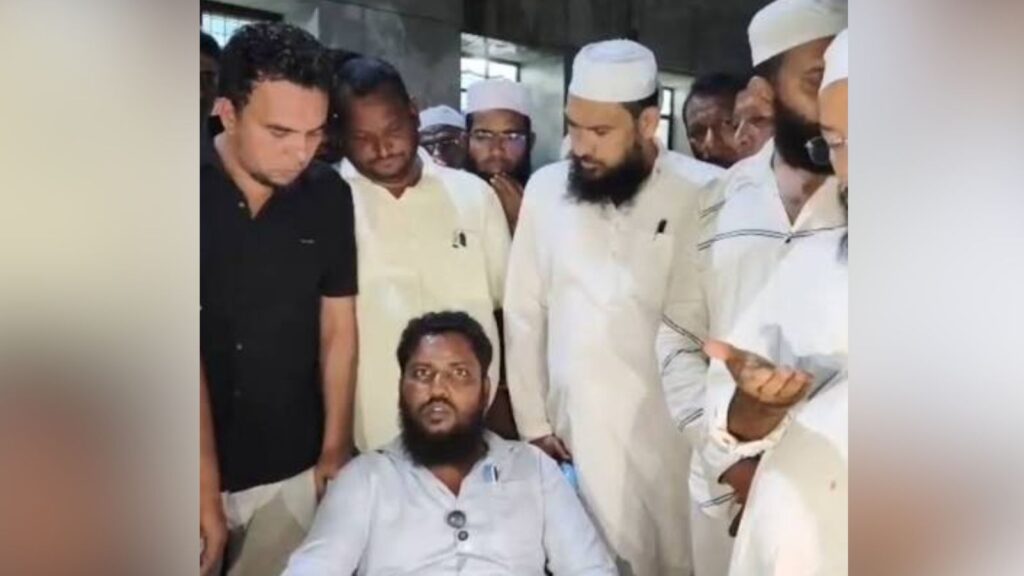
Amer Khan alleged that an angry group led by Balu stormed the private school and assaulted him. Balu, a BJP leader, claimed that children were being taught “Urdu songs” and the “kalma,” that they “had Urdu writings in their books” and that he had noticed “behavioural changes” in them.
The claim collapsed on contact with the facts. Urdu is taught in Telangana schools primarily as an optional first, second or third language under the state’s language policy, and is also offered as a primary medium of instruction in dedicated government Urdu-medium schools. Bharat Chandra School is private and it is headed by Hindus.
“The Urdu classes were intended for Muslim students only. But at that time, no empty classes were available due to construction work. We decided to make them sit with Hindu students. That is where he erred,” Amer told Siasat.com.
Only two Urdu classes were conducted. After parents complained, the classes were discontinued and the matter was resolved peacefully. It stayed that way until Balu disrupted it. Siasat.com has learnt that the issue was resolved four days before the slap incident.
Cases were filed against both Balu and Khan. Balu got conditional bail within 24 hours of his remand. Khan’s complaint was not filed to begin with. He said the Armoor station house officer refused to register his counter-complaint on the ground that a case already stood against him.
Video asked to be deleted
The Armoor video spread quickly. So did the effort to remove it.
Telangana Police directed X to take down the assault video from 41 handles. Siasat.com was among those served notice to delete it.
Majlis Bachao Tehreek (MBT) spokesperson Amjed Ullah Khan, who has actively highlighted hate crimes in Telangana and Hyderabad, said this is not new. “There have been several instances in the past where the state government and the Telangana Police have attempted to suppress voices raised against atrocities on Muslims. When the Armoor case erupted, around 48 social media accounts speaking against the incident were silenced,” he alleged.
His larger charge is directed at the Congress government. Accusing it of pursuing soft Hindutva politics, he said, “Revanth Reddy is running a Congress inside a Congress. It’s all lip service, no action.”
A very telling quarter
Seven cases are a better number than 27. It is not, on its own, evidence of anything.
Set the incidents beside their outcomes and a different quarter emerges. Four men arrested over the Jagtial attack, out in a fortnight. A driver assaulted over a consignment of plywood, his case going nowhere. A BJP functionary who slapped a principal in front of the police, bailed within 24 hours. A principal who was hit, refused a complaint, and is now asking a High Court to protect him from arrest. A video that went massively viral, pulled from 41 accounts.
The count may fall again next quarter. The arithmetic of who gets bail and who gets booked shows no sign of changing.
(This is the second in Siasat.com’s quarterly documentation of religious hate crimes in Telangana. The first quarter report can be read here)
 |
|