

New Delhi: For months, Delhi’s Jantar Mantar has been the hotbed for student protests where Gen Zs have actively sought accountability from the Narendra Modi-led Union government, be it on the alleged NEET irregularities or the ongoing Special Intensive Revision (SIR). On Monday, October 12, the Union Home Ministry denotified that very site, raising several questions about the intent of doing so.
The Jantar Mantar protest site lies in close proximity to the 300-year-old Jantar Mantar monument, built in the 18th century by Rajput king Maharaja Sawai Jai Singh II of Amber, who served under the Mughal Emperor Muhammad Shah, the great-grandson of Aurangzeb. This beautiful piece of architecture was built for astronomical purposes.
In short, to tell time.




Before Jantar Mantar, it was Boat Club Lawns
Jantar Mantar was not the first choice for protesters. Earlier, demonstrations happened in Boat Club Lawns, located near India Gate on Kartavya Path.
It changed 30 years ago, when in 1988, the then president of Bharatiya Kisan Union (BKU), Mahendra Singh Tikait (father of Rakesh Singh Tikait), led a fierce farmers’ agitation against the Rajiv Gandhi government, demanding electricity bill waivers and higher sugarcane prices.
By 1993, soon after the infamous Babri Masjid demolition and the subsequent riots, the then government in power banned any demonstration in the Boat Club Lawns and shifted it to Jantar Mantar road, around two kilometres away, close to Old Parliament.

At the time, it seemed like the ideal venue. The site could not hold a big crowd, and its two main entry and exit points made it easier for the administration to manage.
Jantar Mantar of today
Nearly two decades later, Jantar Mantar became the centre of a nationwide anti-corruption movement led by activist Anna Hazare. On April 5, 2011, Hazare began an indefinite hunger strike demanding a stronger Jan Lokpal Bill to tackle corruption.
He broke his fast five days later after the Manmohan Singh-led Central government gave assurances. The assurances did not translate into action and Anna planned another protest. Delhi Police detained him before it began, citing restrictions. The movement was subsequently shifted to Ramlila Maidan after the police’s permission.

In December 2012, the site and its surroundings became an important location for demonstrations following the brutal gangrape of a woman in a moving bus in the capital. The woman, who came to be known as Nirbhaya, died of her injuries, triggering widespread outrage across the country.
Thousands of protesters, particularly young people, took to the streets demanding justice for the victim and stronger laws to protect women.

In 2014, protests also followed the death of Nido Tania, a student from Arunachal Pradesh who was allegedly assaulted in southeast Delhi. The incident sparked anger over racial discrimination and violence against people from the Northeast, with demonstrators demanding justice and measures to prevent such attacks.

In 2017, Tamil Nadu farmers staged a 41-day protest to highlight agrarian distress, seeking relief from mounting debts, drought-related losses and other problems affecting their livelihoods.

December 2019 saw strong student protests against the Citizenship (Amendment) Act (CAA) and the National Register of Citizens (NRC). Young minds from important central universities like Jawaharlal Nehru University (JNU), Jamia Millia Islamia and Delhi University, civil society groups and politicians challenged the Centre’s citizenship policies, demanding a rollback.
On January 20, 2020, hundreds of students marched from Mandi House to Jantar Mantar, raising slogans ‘Not In My Name’ and ‘India rejects NRC.’
The protest saw the arrest of JNU scholars Umar Khalid and Sharjeel Imam under the draconian Unlawful Activities Prevention Act (UAPA) and the Arms Act, and to date, they are incarcerated in Tihar Jail without a trial.

The site became the focal point of demonstrations surrounding a high-profile sporting controversy in 2023, when prominent wrestlers, including Olympic medallists, staged a sit-in against then Wrestling Federation of India (WFI) chief Brij Bhushan Sharan Singh. The wrestlers accused him of sexually harassing women athletes, demanding arrest and action.

In 2026, student protests rose again, this time led by Gen Zs, with young demonstrators demanding accountability from the Narendra Modi-led Union government.
Following the NEET paper leak on May 3 and 16 reported suicides in its aftermath, students led by the Cockroach Janta Party and other student organisations, along with Sonam Wangchuk, staged protests at Jantar Mantar. They demanded the resignation of then Union Education Minister Dharmendra Pradhan, alleging that the Modi government and the Ministry of Education had failed to respond to the crisis.
Wangchuk also began an indefinite hunger strike. The movement gained momentum following his detention by Delhi Police, triggering widespread protests across the national capital. Within a month, Pradhan resigned.

Now, protests have resurfaced again, this time seeking the resignation of Chief Election Commissioner Gyanesh Kumar over the removal of more than 13 crore names from voter lists in the ongoing Special Intensive Revision (SIR) of electoral rolls, which allegedly benefited the Modi government, especially in West Bengal, capturing power for the first time.
CJP had called for a ‘Chalo Jantar Mantar’ protest on Friday, October 10. This time, the demonstration did not happen as protesters, including politicians, were stopped by a heavy security deployment and mass detentions.
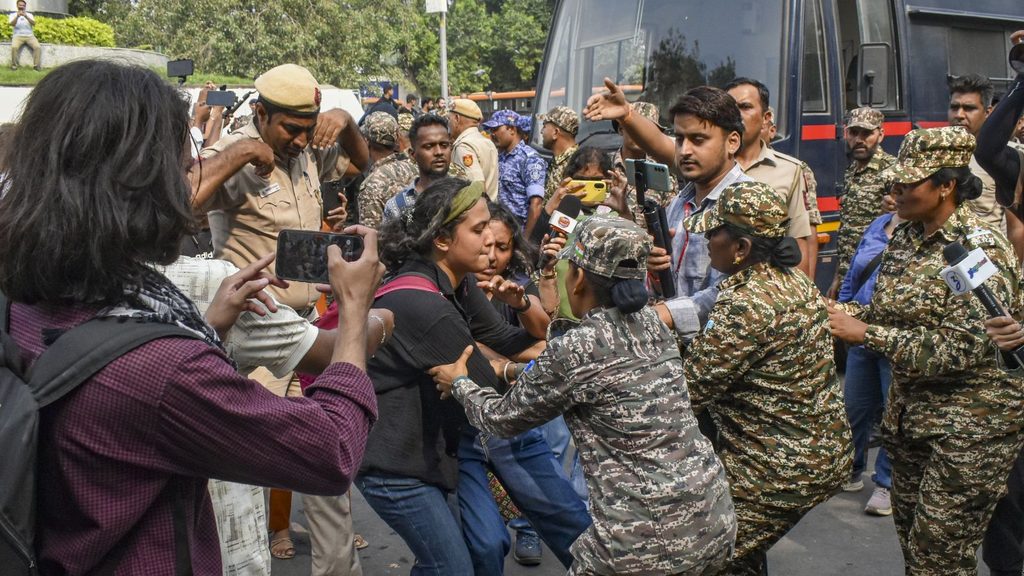
On the same day, observing the internet and Delhi Metro stations shutdown and the mass detention of students, journalists, politicians, lawyers and the common folk, the Supreme Court of India passed an order directing the Centre to undo all of it and ensure peaceful protests in place.
But it also said, “To that end, suitable alternative sites capable of housing such infrastructure need to be identified and designated.”
And the Delhi Police did just that. It issued a fresh Standing Order on the recommendations of a committee of the Union Home Ministry to disallow Jantar Mantar as a protest site. The three protest venues now are CBD Ground in East Delhi, Ramlila Ground where Central Delhi meets Old Delhi and Burari Ground on the city’s northern outskirts.
This shows govt is scared: Reactions
The denotification has raised many questions, if not strong criticism.
In pure sarcasm, prominent journalist Rajdeep Sardesai said he waits for the day when the word “protest” is erased.

Cockroach Janta Party (CJP) has asked the Modi government if democracy is next on its denotification list.

Its leader and co-covenor, Saurav Das, said the decision is unacceptable. “It is the people’s Jantar Mantar. We will absolutely not accept it. You know how many protests used to take place at Jantar Mantar and India Gate, which was also an iconic venue for peaceful public protests. Now they have taken Jantar Mantar away from us. Who knows what else they might take away or what further restrictions they might impose?”
“Did you consult the people? Did you consult the stakeholders? Did you speak to the various organizations that regularly come to Jantar Mantar, where protests take place every day? Did you ask them what they thought of your proposal?…”
Senior Congress leader and former Haryana chief minister Bhupinder Singh Hooda said the fear is cleary showing.
Senior Communist Party of India (Marxist) leader MA Baby said this decision will bring more chaotic situation for the country.
Beyond large-scale agitations, Jantar Mantar has, time and again, witnessed lone protesters travelling from distant corners of the country in the hope that their voices would reach those entrusted with the responsibility of addressing their grievances. Its significance lay not merely in the size of crowds it drew, but in its proximity to the institutions they sought to hold accountable.
(With PTI inputs)
(Click here for LIVE updates on the CJP protest)
 | Edited by Osama Salman | |